Corporate History
Applied Agricultural Resources Sdn. Bhd (AAR) is formerly known as Applied Agricultural Research Sdn. Bhd. Advanced Agriecological Research Sdn. Bhd. is a wholly owned subsidiary of Applied Agricultural Resources Sdn. Bhd.
It has emerged as a leading tropical plantation crop research centre since its establishment in July 1986. It advises over 400,000 hectares of oil palm, rubber and cocoa estates in Peninsular Malaysia, Sabah, Sarawak and Indonesia. AAR is an associate company of Boustead Plantations Berhad and Kuala Lumpur Kepong Berhad, two highly successful public-listed Malaysian companies.
AAR maintains a large research programme in strategic areas to improve productivity and efficiency in estates. It ultilises the latest research findings, innovations and technological advances in crop science and information technology that are applicable. Consequently, estates advised by AAR benefit from timely transfer of new R&D findings and improved planting techniques against a background of sound agronomic and management practices.
To service its clients, AAR has an excellent mix of skilled and experienced field, laboratory and office staff, led by over 60 professional researchers. Team work and thorough objectives studies are prominent features in AAR’s approach to resolve production and management problems in estates. AAR staff work effectively together to ensure a consistent high standard of work.
As producers of essential natural commodities for the global market, our estates will continue to feature prominently in Malaysia’s economy and provide a competitive edge to our country’s industrial sectors. AAR is committed to be at the forefront of plantation research and development, propelling our estates to be highly efficient,productive and sustainable with their eco-friendly oil palm, rubber, cocoa estates and plantation forest into the 21st century.
Corporate Vision/Mission
AAR’s Vision

AAR’s Mission
-
To help our principals achieve highest productivity and efficiency and thus maximize profits and best results through sustainable crop practices and advanced planting materials.
-
To continually develop and improve planting practices and planting materials for our Principal and advisory estates.
AAR’s Objectives
-
To improve productivity and efficiency of oil palm estates through site-specific practices.
-
To raise the yield plateau and improve desirable secondary characteristics of oil palm planting materials through improved hybrid seeds and/or clonal materials.
-
To seek improved planting practices, systems or equipment which will raise productivity of the crop and /or labour.
-
To seek effective planting practices, systems or equipment which are worker and manager-friendly i.e. which are simple to understand and implement or operate.
Last updated: 19-Mar-2010
Agronomic Advisory Services
|
AAR was set up to provide sound agronomic advice and assist its Principals’ and client estates to achieve the highest sustainable yield and profit. The advisory services cover main plantation crops grown in Malaysia i.e., oil palm, rubber, cocoa and coconut but as the latter three crops have progressively been replanted, oil palm is now the main crop advised. |
|
|
The whole team of AAR agronomists is engaged in providing advice on best agriculture practices and annual fertiliser recommendations, besides carrying out its agronomic research programme. The advisory services are backed up by a whole array of traditional analytical and diagnostic services of field visit and thorough field inspections, monitoring and analysis of growth and yield, pest and disease control, leaf and soil analysis, drainage planning etc. In addition, digital analytical and diagnostic techniques are adopted to check the growth and yield status of fields and variations within for improvement. Digital terrain models are used for planning to improve drainage, planting terraces and field infrastructure preparations in new and replanting areas. |
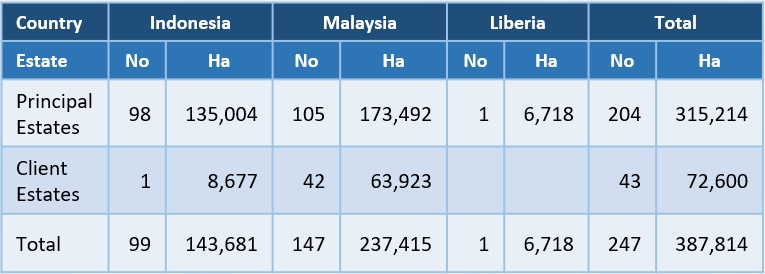
The Oil Palm Agronomic Advisory Services of AARSB and its sister company PTAARI in Indonesia cover the following countries, estates and hectarages in 2021.
|
|
The primary functions are to identify yield reducing factors for site-specific correction and draw up variable fertiliser rates for individual manuring blocks or fields to achieve their site yield potentials. Key feature of the AAR system is its holistic and site-specific approaches in evaluating agro-management practices and examining yield gaps in individual fields backed by detailed palm performance, field assessment and analysis, diagnostic and weather data in AAR’s digital database dated back to the 1960s. |
|
|
Estimated nutrient requirements and cost of recommended fertiliser applications are presented with relevant field notes in agronomic recommendation reports annually. Follow-up visits to monitor progress for rectification are made when necessary. |
|
|
Digitised maps, GIS, GPS, Decision Support Systems and nutrient balance models developed from AAR’s fertiliser trials have been used alongside the traditional yield, growth, leaf and soil analysis and climatic data for more effective, balanced and precise fertiliser recommendations. From 2015, enhanced remote sensing images have been included in the array of field diagnostic tools to pin-point under-performing palms and evaluate status and progress of improvement in palm growth. AAR agronomists are also engaged in relevant agronomic research programmes to gain additional insights, essential knowledge of palm responses and greater appreciation of natural variations in the fields. |
|
|
AAR also conducts soil surveys (usually at a semi-detailed level) and carries out soil inspections and desktop feasibility studies for oil palm cultivation. Additional adhoc studies on drainage improvement, flood mitigation and other detailed site studies on pest and disease infection and agro-management issues are also made for non-principal clients when time permits. |
|
|
Nevertheless, AAR still maintains a specialist rubber agronomy section to serve the remaining small rubber areas (approximately 10,000 ha) in one of its Principals’ estates. This is also to preserve the crop management and agronomy knowledge accumulated at AAR over the years. |
|