
Papers : Others
Chan K.S. and Chew P.S. 1987. Boric acid and fertiliser borate for improved urea fertiliser efficiency. International Symosium. on Urea Technology and Utilization, 1987. Preprint.
Chan K.S. and Chew P.S. 1988. The choice of a foliar fertiliser. The Planter. Incorporated Society of Planters, Kuala Lumpur 66 (774) : 473-479.
Chan K.S. 1988. Report on Local Plant Analysis cross-checks 1986 and 1987. 9th Seminar on Standardisation of Soil and Plant Analysis.
Chan K.S. 1993. Fertiliser analysis cross-checks in Malaysia 1990-1991. Proc. Seminar on Progress in Soil, Plant and Fertilizer Analysis, Malaysian Society of Soil Science, Sabah : 121-135
Chan K.S. 1994. Fertiliser analysis cross-checks in Malaysia 1992-93. Seminar on advances in Soil, Plant and Fertilizer Analysis and the 12th Standardisation Meeting.
Chan W.H. and Goh K.J. 1997. A short note on effective advisory service in the private section. ISOPA Newsletter Vol. 6 : 1-3
Chang H.F. and Petronella G.A.T. 2014. Quantification of measurement uncertainty using AgLAM fertiliser proficiency testing data. Seminar on Advances in Soil, Plant and Fertilizer Analysis, 25 to 27 Nov., Kuching.AgLAM, Kuala Lumpur. Preprint.
Chew P.S. 1991. Report on biological sciences/biotechnology grouping to the Chairman, Strategic sector, IRPA panel on IRPA strategic sector national seminar 16-19/12/91.
Chew P.S. 1995. KLK Annual Managers’ Conference 1995 : Panel Discussion on prospects and challenges of the plantation industry in Malaysia.
Chew, P. S. 1996. Industry’s low OER problems – impact, outlook and implications. The Planter. Incorporated Society of Planters, Kuala Lumpur (72) : 273-290.
Chew P.S., Soh A.C. and Goh K.J. 1998. Notes on Revitalising Plantation Agriculture in Malaysia. The Planter. Incorporated Society of Planters, Kuala Lumpur 73 (854) : 247-253.
Gan H.H. and Goh K.J. 2003. Some useful statistics and statistical methods for analytical laboratories. Presented at Seminar on Advances in soil, plant and fertilier analysis (ASPFA 2003), September 9-10, Kuantan, Pahang. Preprint.
Kee K.K. 1995. Regional rainfall pattern and climatic limitations for plantation crops in Pen. Malaysia. 1st pub. AAR Research News, Jan. ’89 issue; 2nd pub. N. Sembilan Planters Association Annual Journal. 3rd pub. The Planter. Incorporated Society of Planters, Kuala Lumpur 71 (827) : 67-78.
Kee K.K. 1996. Runoff and erosion studies – Trial NB5-91. Proc.Seminar/Field Dayat Kalumpang Development Corporation, Tawau.Applied Agricultural Research Sdn. Bhd., Selangor : 72-80.
Moradidalini A., Teh C.B.S., Goh K.J., Husni, M.H.A. and Ishak, C.F. 2014. Decomposition and nutrient release temporal pattern of oil palm residues. Ann ApplBiol 164: 208–219
Ng H.C.P., Chew P.S., Goh K.J., Gan H.H. and Heng Y.C. 2000. Planter’s toolbox in the 21st century. In: Pushparajah, E. (ed). Proc. International Planters Conference on Plantation Tree Crops in the New Millenium : The Way Ahead. Incorporated Society of Planters, Kuala Lumpur : 717-737
Petronella G. and Tan L.H. 2001. Fertilizer analysis cross-checks in Malaysia 1999-2000 Seminar on Quality and Advances in Soil, Plant and Fertilizer for the millennium held at Kota Kinabalu from 3 to 4/10/01. Preprint
Petronella G. and Tan L.H. 2003. Fertilizer analysis cross-checks in Malaysia 2001-2002. Seminar on Advances in Soil, Plant and Fertilizer for the millennium held at Kuantan, Pahang. Also presented at IKM advanced workshop on measurement uncertainty in chemical analysis – case studies at Penang on 30/7. Preprint.
Petronella G. and Tan L.H. 2004. Fertilizer analysis cross-checks in Malaysia 2003-2004 Seminar on Advances in Soil, Plant and Fertilizer Analysis for the millennium held at Miri, Sarawak. Preprint
Petronella G. and Tan L.H. 2005. Addition of cations to urea does not necessarily reduce N volatilisation losses. In : Teh C.B.S., Zin Z.Z., Izham A., Fauziah I., Osmanu H.A. and Wan Noordin W.D. (eds). Proc. Soils Conference on advances in soil science for sustainable food production. Malaysian Society of Soil Science : 61-64.
Petronella G. and Tan L.H. 2008. Fertiliser analysis cross-checks in Malaysia 2005-2007. Presented at Seminar Advances in Soil, Plant and Fertiliser Analyses, Langkawi from 16 to 17 January. Preprint.
Petronella G.A.T. 2010. Fertiliser analysis cross-checks in Malaysia 2008-2009. Seminar on advances in soil, plant and fertiliser analysis held 12-21 October.
Petronella G.A.T. and Tan L.H. 2014. Fertilizer proficiency testing programme in Malaysia 2013. Seminar on Advances in Soil, Plant and Fertilizer Analysis, 25 to 27 November, Kuching.AgLAM, Kuala Lumpur. Preprint.
S.M.F.D. Syed Mustapha, S.T. Bong and Goh, K.J. 2000. Measuring Performance of Probabilistic Inferencing and K-Nearest Neighbor for the Best Month Fertilizer Application. In: Hamza M.K. (ed). Artificial Intelligence and Soft Computing, IASTED/ACTA Press Banff, Alberta, Canada: 380-385.
Shahrakbah Y. 2009. Impact of fertilizer price on fertilizer use. Guest Editorial. The Planter. Incorporated Society of Planters, Kuala Lumpur : Vol.85 No.995, 65-66.
Tang S.Y., Hara S., Melling L., Goh K.J. and Hashidoko Y. 2010. Burkholderia vietnamiensis isolated from root tissues of Nipa palm (Nypa fruticans) in Sarawak, Malaysia, proved to be its major endophytic nitrogen-fixing bacterium. Bioscience, Biotechnology and Biochemistry 74(9): 1972-1975.
Teh C.B.S., Henson I.E, Goh K.J. and Husni M.H.A. 2004. The effect of leaf shape on solar radiation interception. In: Shamsuddin Z. et al. (eds). Agriculture Congress: Innovation towards modernized agriculture (2004 Sri Kembangan). Book of Abstracts of AGRICONGRESS. Malaysia International Exhibition and Convention Centre (MIECC), Selangor, Malaysia, Oct. 4-7, 2004: 145-147. Also published in Jr of Tropical Plant Physiology 1 (1) 2006:12-26.
Zaharah A.R., Gikonyo E.W., Silek B., Goh K.J. and Soltangheisi A. 2014. Evaluation of phosphate rock sources and rate of application on oil palm yield grown on peat soils of Sarawak. Journal of Agronomy 13 (1):12-22.
Records 1 to 29 of 29
Coconut: Planting
COMMERCIAL COCONUTS AND COCOA PLANTINGS ON ACID SULPHATE SOILS
Young Coconuts
There are no young MAWA coconut areas in our group on acid sulphate soils. However, 133 ha of MAWA hybrids were replanted in Estate 1 following rubber in 1980 and 1981 on Briah/Java/Sedu series soils. At the commencement of field preparation, the detailed soil maps were not yet available and following soil pH tests which showed values below pH 3.6 and 4.1 in the top 15 cm, the areas were treated as potentially acid sulphate and field preparations made accordingly. A brief description of the planting practices adopted is given:-
• Land preparation and drainage. The old rubber was poisoned, felled and burnt. These precautions were taken to minimise rhinoceros beetle problems.
The cleared land was ploughed and harrowed for weed control, to fit new uniform drainage schemes and to level the areas. The practice is useful for mechanization in future and also to benefit the legume growth by reducing initial weed competition.
New drains were then dug at the specifications decided, usually 1 m (width) x 1 m (depth) x 0.5 m (bottom width) at every fourth palm row.
The management was encouraged to practise water management by keeping the water table at 75 cm depth where possible by using weirs in the drains.
• Planting practices. Standard polybag nursery practices i.e. using 45 cm x 50 cm size polybags, fertilizer schedule (Appendix 2) and daily watering were adopted with satisfactory growth. Top soil was used to fill the bags.
APPENDIX 2. FERTILISER SCHEDULE FOR MAWA COCONUTS IN POLYBAG NURSERY
|
Months after planting |
CIRP |
CCM25 (kg/bag) |
|
Bag filling |
Mix 200g/bag (45 cm x 50 cm x 500 gauge) thoroughly |
|
|
1 |
5 g |
|
|
2 |
10 g |
|
|
3 |
15 g |
|
|
5 |
20 g |
|
|
7 |
40 g |
|
|
9 |
40 g |
Leguminous covers were planted in these areas. Again, standard techniques were used although in the acid sulphate areas, liming at 2.5 to 5.0 tons per ha was suggested with apparently beneficial effects to the legumes. Difficulty in establishing and maintaining the legumes in these areas was experienced due to abnormal flooding and probably high acidity. Results obtained usually were legume/grass mixtures.
Normal ring weeding of the palms was carried out to minimise weed competition with the palms.
• Fertiliser application. The fertilizer schedules followed in the acid sulphate areas are given in Appendix 3.
APPENDIX 3. SUGGESTED FERTILISER SCHEDULES (KG/PALM) FOR HIGH YIELDING HYBRID COCONUTS ON ACID SULPHATE SOILS (CHEW, 1982)
| Year |
Linau-Sedu Ass. |
||||
|
CCM 77 |
Urea |
CIRP |
M.Potash |
Mg. Limestone |
|
| 1 |
1.00 |
– |
0.75 |
– |
3.0 |
| 2 |
– |
0.75 |
1.00 |
1.25 |
– |
| 3 |
– |
1.50 |
1.50 |
2.00 |
3.0 |
| 4 |
– |
1.50 |
1.50 |
1.50 |
– |
| 5 |
– |
1.25 |
– |
1.25 |
– |
| 6 |
– |
1.25 |
– |
1.25 |
– |
| 7 |
– |
1.25 |
– |
1.25 |
– |
| 8 |
– |
1.25 |
– |
1.25 |
– |
The high rates are to ensure good early establishment and precocious yields for which the MAWAs are famous.
The early growth of the planted MAWAs appeared satisfactory. Only problems were damage by rhinoceros beetles.
Old Coconuts
The policy in all coconut areas is to intercrop with cocoa to maximize profits. Most of the coconut areas on the acid sulphate soils are (>25 yrs) and were planted with a mixture of dwarfs, natural hybrids in 1954/55, at close density for dwarf palms (approx. 6.7 m). Planting practices in these areas are discussed and compared with similar coconut palms planted on non-acid sulphate soils (Sabrang and Briah series) in Estate 2 probably from the same seed palms as Estate 1 and dwarf palms on comparable age in another non-acid sulphate soil (Bernam/Selangor series) in Estate 3.
• Planting practices. All areas are inter-cropped with cocoa. As this was carried out over a period of years from 1968 and with some considerable conflicting views, planting density and spacings of the cocoa varied considerably but were usually very dense at 750 to 1100 bushes per ha initially and recently thinned down to 530 to 750 bushes per ha.
The ground cover is usually bare of vegetation in view of the dense shade of the cocoa and coconuts and also the deliberate policy of the management to keep out all ground vegetation.
Coconut husks, after removing the nut, which used to be burnt in pre-cocoa planting days are now usually left scattered in heaps in the interrows.
• Water management. This is stressed in the acid sulphate areas in view of the need for adequate drainage with cocoa planted in the areas and also the potential dangers of higher acidity developing in the soil on over-drainage. Water tables in the acid sulphate areas fluctuated from 0.3 m to 1.2 m but were mostly 0.6 m to 0.9 m.
Often however, with the seasonal rainfall of the estates, excessive water or absence of it was the problem and largely outwith the control of the management.
• Nutrition. The coconuts were fertilized sparingly as seen in Table 3.
TABLE 3. NUTRIENTS (KG/PALM) APPLIED TO COMMERCIAL COCONUT AREAS (1974 TO 1982)
| Est. | No.of fields | Soils | No. of years applied |
Nutrients (kg/palm) |
||||||
|
N |
P205 |
K20 |
Mg0 |
Limestone | ||||||
| 1 | 4 | Acid Sulphate areas (81% Sedu Series, 1.2% Guar Series) | 5-8 | Mean |
1.68 |
0.51 |
0.28 |
1.79 |
13.4 |
|
| Range |
1.34-2.12 |
0.33-0.68 |
nil-0.82 |
1.38-2.11 |
9-18 |
|||||
| 1 | 4 |
Less Acid Sulphate Areas (44% Sedu Series, 27% Selangor Series, 13% Java Series) |
5-6 | Mean |
1.28 |
0.33 |
0.24 |
1.29 |
13.2 |
|
| Range |
1.08-1.34 |
0.33 |
nil-0.41 |
1.0-1.76 |
7-16 |
|||||
| 2 | 4 | Sabrang and Briah Series | 5-7 | Mean |
1.63 |
0.48 |
0.34 |
nil |
nil |
|
| Range |
1.06-2.00 |
0.43-0.59 |
nil-0.82 |
nil |
nil |
|||||
| 3 | 3 | Bernam/Selangor Series | 8 | Mean |
2.57 |
0.36 |
0.63 |
nil |
nil |
|
| Range |
2.43-2.74 |
0.36 |
0.41-0.95 |
nil |
nil |
|||||
Fertiliser rates are drawn up on available general information of the nutrient requirements of the palms, leaf and soil analysis results and the fertilizer application made to the cocoa, nutrient requirements of the latter and expected profitability of fertilizer applications made.
Only magnesium applications as magnesium limestone and calcium limestone application were applied at high rates in the acid sulphate areas.
The other feature in the fertilizers applied is the higher nitrogen and potassium application on the Bernam/Selangor series areas. This is in view of the expected responses to nitrogen and the lower leaf K levels.
Applications were withdrawn in the last two years on very low copra prices.
Leaf and soil analysis data on the acid sulphate areas are given in Table 4 and 5 and compared to non-acid sulphate areas.
| Est. | Soils |
No.of yearsanalysed |
Frond 14 (% on d.m.) |
||||
|
N |
P |
K |
Mg |
Ca |
|||
| 1 | Acid sulphate areas (81% Sedu Series, 12% Guar Series) |
10 |
1.90-1.95 |
.125-.131 |
.84-.97 |
.23-.25 |
.14-.19 |
| 1 | Less Acid Sulphate areas (44% Sedu Series, 27% Selangor Series, 13% Java Series) |
10 |
1.90-1.93 |
.130-.135 |
.81-.89 |
.18-.34 |
.15-.20 |
| 2 | Sabrang and Briah Series |
9 |
1.88-1.90 |
.128-.133 |
.76-.84 |
.33-.38 |
.18-.21 |
| 3 | Bernam/Selangor Series |
10 |
1.80-1.82 |
.135-.137 |
.57-.61 |
.44-.45 |
.18-.19 |
The soil analysis results given for individual fields in the coconut areas discussed are for fertilized areas in the cocoa interrow areas and mainly unfertilized areas (except for limestone) between the coconut palms.
Soil pH results (air-dry soil) of topsoil samples after 1980 are above four units in all cases. Earlier analysis showed lower pH in the acid sulphate areas but these were subsequently corrected by liming.
Organic carbon, nitrogen and phosphorus contents are higher on the Sedu series than on Bernam series but have lower base cations. Limited analysis results are available for the Sabrang and Briah series areas. Their soil nutrient contents for available P and the exchangeable cations appear similar to the Bernam series.
Nutrients applied to the cocoa are shown in Table 6.
TABLE 6. NUTRIENTS (KG/BUSH) APPLIED TO COCOA AREAS (1976-1982)
| Est. | Soils |
No.of years applied |
Nutrients (kg/bush) |
|||||
|
N |
P205 |
K20 |
Mg0 |
Limestone |
||||
| 1 | Acid Sulphate areas (81% Sedu Series, 1.2% Guar Series) | 7 | Mean |
.43 |
.36 |
.49 |
.09 |
7.21 |
| Range |
.28-.51 |
.11-1.01 |
.40-.55 |
.05-.10 |
6.0-8.4 |
|||
| 1 |
Less Acid Sulphate Areas (44% Sedu Series, 27% Selangor Series, 13% Java Series) |
7 | Mean |
.45 |
.11 |
.55 |
.08 |
6.5 |
| Range |
.35-.63 |
.06-.18 |
.46-.71 |
.05-.10 |
4.8-9.0 |
|||
| 2 | Sabrang and Briah Series | 7 | Mean |
.58 |
.25 |
.52 |
nil |
5.7 |
| Range |
.43-.63 |
.22-.27 |
.42-.58 |
nil |
5.3-6.0 |
|||
| 3 | Bernam/Selangor Series | 7 | Range |
.64 |
.15 |
.44 |
nil |
1.1 |
High limestone applications were again made in the acid sulphate areas. Applications of nitrogen and phosphorus were lower than on the other soils with approximately similar potassium values.
Leaf analysis results of the cocoa are given in Table 7.
TABLE 7. LEAF ANALYSIS RESULTS OF SOME COMMERCIAL COCOA AREAS ON COASTAL CLAY SOILS
| Est. | Soils |
No. of yearsanalysed |
Leaf analysis results (% on d.m.) |
||||
|
N |
P |
K |
Mg |
Ca |
|||
| 1 | Acid Sulphate areas (81% Sedu Series, 1.2% Guar Series) |
4-8 |
2.13-2.25 |
.139-.165 |
1.57-1.83 |
.57-.67 |
.87-1.43 |
| 1 |
Less Acid Sulphate Areas (44% Sedu Series, 27% Selangor Series, 13% Java Series) |
3-9 |
2.05-2.13 |
.146-.154 |
1.50-1.86 |
.57-.83 |
.84-1.03 |
| 2 | Sabrang and Briah Series |
5-6 |
2.00-2.06 |
.146-.158 |
1.37-1.72 |
.82-.90 |
.68-.85 |
| 3 | Bernam/Selangor Series |
2-7 |
1.91-2.06 |
.142-.166 |
1.70-1.74 |
.79-.93 |
.69-.80 |
The feature of the results may be higher N and Ca values in the acid sulphate areas.
• Yields of the coconuts. The coconut yield results in the areas discussed are shown in Table 8 with individual year yield trends in Figure 1.
TABLE 8. COMPARISON OF COCONUT YIELDS (1970-1982) ON ACID SULPHATE AND OTHER COASTAL CLAY SOIL AREAS
| Est. | Soils | Year Planted | Planting Material | Stand/ha |
Copra(kg/ha/yr) |
Copra |
| 1 | Acid Sulphate areas (81% Sedu Series, 1.2% Guar Series) | 1954/55 | Mixed Malayan Dwarfs/hybrids | ~ 244, thinned to ~ 210 in 1979/1980 |
1762 ± 79 |
8.79 ± 0.9 |
| 1 |
Less Acid Sulphate Areas (44% Sedu Series, 27% Selangor Series, 13% Java Series) |
1954/55 | Mixed Malayan Dwarfs/hybrids | ~ 253, thinned to ~ 204 in 1976/1980 |
2095 ± 81 |
8.62 ± .10 |
| 2 | Sabrang and Briah Series | 1954 | Mixed Malayan Dwarfs/hybrids | ~ 270, thinned to ~ 220 in 1978 |
2439 ± 140 |
8.76 ± .46 |
| 3 | Bernam/Selangor Series | 1952 | Malayan Dwarfs | ~ 225 |
1920 ± 145 |
8.42 ± .28 |
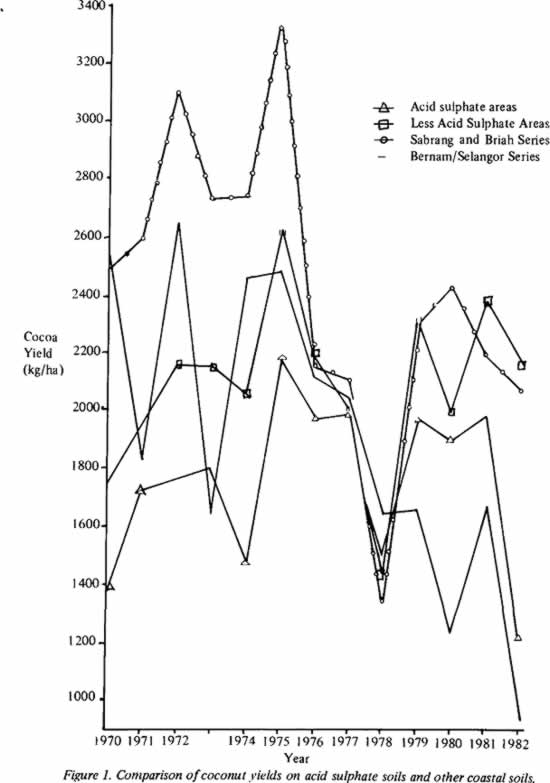
In the Malayan dwarf/hybrid areas, there is a gradation of yield increase from the acid sulphate areas to the non-acid sulphate Sabrang and Briah series areas. Yield over the period considered (approximately year 16 to 28) was 38 per cent higher in the non-acid sulphate area. This would be larger probably but for the thinning carried out in 1978 which reduced differences considerably.
The mean yields in the Malayan Dwarf area on the Bernam/Selangor series area appeared comparable to the acid sulphate areas only. However, this may be misleading as unusually poor results (possibly related to abnormally very high rainfall on the estate) were obtained in the last four years despite no thinning carried out.
Copra content figures do not appear to show differences between the different soil areas. However, again this may be misleading due to differences between the years and possibly estate recording methods (Table 9). Copra content is probably better in non-acid sulphate areas.
| Estate | Soil Series |
Copra content (nuts/kg) |
|||||
| 1971 | 1972 | 1973 | 1980 | 1981 | 1982 | ||
| 1 | Acid Sulphate | 8.75 ± .35 | 8.76 ± .29 | 8.93 ± .14 | 8.96 ± .16 | 8.26 ± ..05 | 8.76 ± .14 |
| 1 | Less Acid Sulphate | 8.54 ± .61 | 8.59 ± .30 | 8.76 ± .35 | 8.99 ± .18 | 8.25 ± .11 | 8.80 ± .11 |
| 2 | Sabrang and Briah Series | 7.24 ± .36 | 7.68 ± .13 | 7.87 ± .22 | 7.84 ± 1.26 | 9.85 ± .325 | 12.17 ± .58 |
| 3 | Bernam/Selangor Series | 7.46 ± .24 | 7.73 ± .43 | 7.91 ± .19 | 8.62 ± .27 | 9.45 ± .24 | 11.22 ± .75 |
• Yields of the cocoa. The cocoa were under planted in the coconut areas in several blocks in each coconut field in the acid sulphate areas due to uncertainty of policy and success over 1968-1975. In the other estates, underplanting of cocoa was carried out in 1968 (Bernam/Selangor area) and in 1969/71 in the Sabrang and Briah soil areas. Planting materials were mainly F1 hybrids.
Yields for some of the oldest plantings have been extracted and yield trends with age for these plantings on the different soils are indicated inFigure 2.
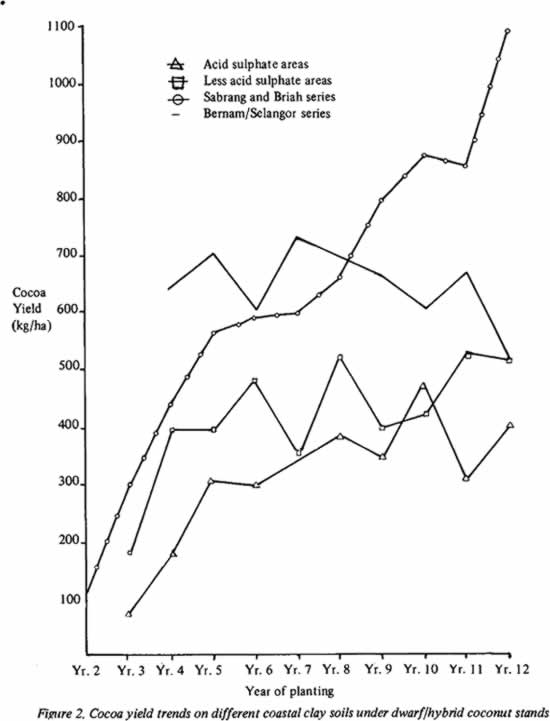
In view of the different planting practices and times, yields up to year five are probably not useful for strict comparison although they indicate that early yield results are also related to acidity of the areas. Yields after year five are shown in Table 10.
TABLE 10. YIELDS FROM COMMERCIAL MATURE COCOA (YR. 6 TO YR. 12) UNDER DWARF/HYBRID COCONUTS ON COASTAL CLAY SOILS
| Estate | Soil series | Coconut shade |
Mean cocoa yieldKg/ha/yr |
Range |
| 1 | Acid Sulphate soils (81% Sedu Series, 12% Guar Series) | Dwarfs/hybrids |
365 ± 56 |
30-40 |
| 1 | Less Acid Sulphate soils (44% Sedu Series, 27% Selangor Series, 13% Java Series) | Dwarfs/hybrids |
460 ± 64 |
30-40 |
| 2 | Sabrang and Briah Series | Dwarfs/hybrids |
732 ± 117 |
30-85 |
| 3 | Bernam/Selangor Series | Dwarfs |
664 ± 47 |
41-43 |
The highest yields were obtained on the Sabrang and Briah series areas under Dwarf/hybrid coconuts. This area outyielded the acid sulphate areas by 59 per cent and 100 per cent. The less acid sulphate areas outyielded the acid sulphate area by 26 per cent. The cocoa in the Bernam/Selangor series outyielded the acid sulphate areas by 44 per cent and 82 per cent.
Absolute yield levels were very low under the generally heavy shade conditions in the acid sulphate areas and even in the non-acid sulphate areas. Improved yield responses seen in Figure 2 in the Sabrang and Briah series area is in part due to reduced shade levels from palm thinning carried out in 1978.
Reference
Chew P.S., Kee K.K. and Ooi L.H. 1984. Management of coconuts and cocoa on acid sulphate soils. The Planter. Incorporated Society of Planters, Kuala Lumpur 60 (704) : 483-498.
Note: The full list of references quoted in this article is available from the above paper.
Papers : Techno-economic Management
Chew P.S. 1990. Research and Development on Mechanisation in oil palm estates. The Planter. Incorporated Society of Planters, Kuala Lumpur, Guest Editorial 66 (773) : 384-385.
Chew P.S. 1992. Report on the questionnnaire on research and development requirements for mechanisation on oil palm estates. The Planter. Incorporated Society of Planters, Kuala Lumpur 68 (792) : 147-168.
Chew P.S., Kee K.K., Goh K.J. and Tey S.H. 1994. Further advances in agronomic management of oil palm plantations. In: Goh S.H., Chin A., Tang T.S., Khor H.T., Soon T.K., Ooi C.K. and Tay C.S. (eds). Proc. International Congress on Oils and Fats: Meeting the needs for oils and fats in the 21st century. Malaysian Oil Science and Technology Association (MOSTA) and Trans-event Sdn. Bhd., Lumut, Perak, Malaysia : 214-222.
Chew P.S. 1999. Prospects for precision plantation practices in oil palm. i) Talk at the 17th PORIM PAC Seminar in 1997 and ii) The Planter. Incorporated Society of Planters, Kuala Lumpur 74(873) : 661-684.
Chow K.C. and Ooi L.H. 2000. An improved field practice and mechanisation of ffb evacuation and manuring in oil palm plantations. Seminar on Labour-Saving Approaches and Technologies Towards Oil Palm Cultivation in Sarawak. Incorporated Society of Planters Central Sarawak Branch, Sibu.Preprint.
Gan H.H., Heng Y.C. and Goh K.J. 2001. An improved yield recording and reporting system for oil palm estates with hand-held organiser. Proc. International Palm Oil Congress on cutting-edge technologies for sustained competitiveness. Malaysian Palm Oil Board, Bangi : 562-567
Goh K.J. 1995. A lecture note on agronomic management in oil palms (point form). Presented at talk to BEA auditors.
Mohd M.M. and Chew P.S. 1985. Oil palm replanting techniques in P. Malaysia. TDM Seminar. Unpublished.
Ng H.C., Chew P.S., Goh K.J., Gan H.H. and Heng Y.C. 2002. IT tools for the management of oil palm. Seminar On Managing Oil Palms For Maximum Yield held on 14 October. Incorporated Society of Planters, North East Branch, Sandakan, Sabah. Preprint.
Ooi L.H. 1996. Some labour saving practices in oil palm plantations. Proc.Seminar/Field Dayat Kalumpang Development Corporation, Tawau. Applied Agricultural Research Sdn. Bhd., Selangor : 22-32
Ooi L.H. 1996. Field day notes on integrated system of harvesting and ffb evacuation. Proc.Seminar/Field Dayat Kalumpang Development Corporation, Tawau. Applied Agricultural Research Sdn. Bhd., Selangor : 91-98
Ooi L.H. 1996. Field day notes on application of fertilizers. Proc.Seminar/Field Dayat Kalumpang Development Corporation, Tawau. Applied Agricultural Research Sdn. Bhd., Selangor : 99-107
Ooi L.H. 1996. Harvesting of tall palms. Proc.Seminar/Field Dayat Kalumpang Development Corporation, Tawau. Applied Agricultural Research Sdn. Bhd., Selangor : 108
Ooi, L.H. 1996. Mechanization of some field practices in oil palm plantations – an overview. Boustead Plantations Managers’ Seminar. Johore Bahru.
Ooi L.H. and Sim B.S. 1997. Impact of two improved oil palm estate practices on labour requirements and production costs. Proc. International Planters Conference on Plantation Management for the 21st Century. Incorporated Society of Planters, Kuala Lumpur : 371-383.
Ooi L.H. 1997. Impacts of the current currency fluctuations on oil palm estates. Mechanization Workshop and Field Day. Boustead Estates Agency, Sandakan, Sabah.
Ooi L.H. 2000. Mechanical Application and Efficient Use of Fertilizer. Taiko Plantations Assistants’ Seminar. Bukit Merah Laketown Resort, Perak.Preprint.
Ooi L.H., Goh T.M., Ang B.N. and Tan K.S. 2001. A new method of clearing oil palm for replanting. Proc. International Palm Oil Congress on Cutting-Edge Technologies for Sustained Competitiveness. Malaysian Palm Oil Board, Kuala Lumpur : 151-158
Ooi L.H. and Tey S.H. 2001. Tracking and weighing of fresh fruit bunches in oil palm estates. Proc. International Palm Oil Congress on Cutting-Edge Technologies for Sustained Competitiveness. Malaysian Palm Oil Board, Kuala Lumpur : 133-145
Ooi L.H., Tey S.H. and Ng H.C. 2001. Innovations to management practices in oil palm estates. Proc. National Seminar on Strategic Directions for the Sustainability of the Oil Palm Industry. Incorporated Society of Planters. Kota Kinabalu, Sabah : 1-9
Ooi L.H., Heng Y.C. and Tey S.H. 2003. Automation of yield recording and yield mapping in oil palm plantations. In : Chan C.W., Teoh C.C., Ten S.T., Yong H.L. and Ibni H.R. (eds.). Proc. Agricultural & Food Engineering Conference : enhancing skills and practices of agricultural and food engineers. Institution of Engineers Malaysia : 32-40. Also published in The Planter. Incorporated Society of Planters, Kuala Lumpur 79(931) : 643-659.
Ooi L.H. 2004 : Cost reduction in ffb production. Guest Editorial. The Planter. Incorporated Society of Planters, Kuala Lumpur : 80(936) : 137-139.
Ooi L.H., Kodiappan P. and GunaRajan M. 2004. Some pulverisation techniques of clearing old palms for replanting. Proc. National Seminar on replant or perish. Incorporated Society of Planters, Kuala Lumpur : 47-63. Also published in The Planter. Incorporated Society of Planters, Kuala Lumpur 80(943) : 631-650. Also presented at the BEA Mechanisation Field Day and Workshop for East Malaysia, 18-19 August 2004.
A modified version entitled: Improved zero burning techniques for replanting old palms, was also presented at the Department of Environment Seminar-cum-Workshop on The Guidelines for The Implementation of The Asean Policy on Zero Burning held in May 2004 in Kuala Rompin, Pahang.
Ooi L.H. and Heng Y.C. 2005. Automation of weighing and recording of oil palm yield in the field. Book of Abstracts 5 ECPA-2ECPLF (5th European Conference on Precision Agriculture), Swedish Institute of Agricultural and Environmental Engineering, Uppsala, Sweden : 226-232
Ooi L.H. and Heriansyah 2005. Palm pulverization in sustainable oil palms replanting. Plant Production Science 8 (3) : 345-348. Poster presentation at the 4th International Crop Science Congress, Brisbane, Australia and for oral presentation at the 5th Asian Crop Science Conference, Brisbane.
Ooi L.H., Loh W.C., Chan K.S., Shafie M.Z., Shahrakbah Y. and Visuvalingam. 2007. Treatment of p.o.m.e. and efb by the zero-waste zero-discharge Boustead Biotherm Palmass Plant. Presented at PIPOC Conference. Preprint.
Paramananthan S., Goh K.J. and Chew P.S. 2000. A framework for land evaluation for oil palm in the 21st century. In: Pushparajah E. (ed). Proc. International Planters Conference on Plantation Tree Crops in the New Millenium: The Way Ahead. Incorporated Society of Planters, Kuala Lumpur : 869-885
Pushparajah E. and Chew P.S. 1998. Integrated nutrient management for sustaining high yields of plantation tree crops in Tropical Asia. Proc. Soil Science Conference of Malaysia. Malaysian Society of Soil Science, Kuala Lumpur : 94-116.
Quah Y.T., Reventhiran N., Thomas T. and Soh A.C. 2002. Mulch system – A procedure for mulching immature oil palm. Plasticulture Congress held in USA in February 2002. Preprint.
Records 1 to 30 of 38
1 | 2
Papers : Geoinformatics
Goh K.J., Chew P.S., Heng Y.C., Tey S.H. and Gan H.H. 1997. Developing decision support systems for plantations : A new role for agronomists. The Planter. Incorporated Society of Planters, Kuala Lumpur 73 (861) : 687-693. Also in ISOPA Newsletter 4 : 3-5.
Haslinda M., Goh K. J., Gan H.H. and Wan Mohamad W. A. K. 2002. A site yield potential model of oil palm : A GIS approach. Proc. MSSS Annual Soil Conference on Applications of Modern Tools in Agriculture. Malaysian Society of Soil Science, Kangar, Perlis : 46-50.
Heng Y.C. 2001. Information Technology AeGIS – combining Geographic Information System and the Database for estate management. BEA Plantation Seminar
McMorrow J.M. and Tey S.H. 2000. The potential of LandsatTM remotely sensed images for oil palm estate management. Proc. International Planters Conference on Plantation Tree Crops in the New Millenium: The Way Ahead. Incorporated Society of Planters, Kuala Lumpur : 769-791
Ng HC, Totok S, Tey SH and Goh KJ. 2012. Remote sensing and digital technologies for plantation management. Presented at XVII International Oil Palm Conference held at Cartagena Colombia from 26 to 28 September.
Ng H.C.P., Totok S., Tey S.H. and Goh K.J. 2012. Remote sensing and digital technologies for plantation management. Presented at XVII International Oil Palm onference held in Cartagena, Colombia from 26 to 28/9/13.
Ooi L.H. and Tey S.H. 1998. Applications of Global Positioning System and Geographical Information System in Oil Palm Estates. Proc.National Seminar on Mechanization in Oil Palm Plantations: “Towards Improving Productivity Through Mechanization”. Palm Oil Research Institute Malaysia, Kuala Lumpur. Preprint. Reproduced in Royal Johore Planters Association Annual Report : 36-43.
Tey S.H. 1996. Desktop mapping services for plantation management and research. Proc. AAR Seminar/Field Day. Kalumpang Development Corporation, Tawau : 45-71
Tey S.H. and Chew P.S. 1997. GIS and GPS Technologies for Management and research in plantation crops. Proc. International Planters’ Conference on Plantation Management for the 21st century. Incorporated Society of Planters, Kuala Lumpur : 47-59.
Tey S.H. 2000. Site-specific practices in oil palm plantation. Presented at Workshop on the application of remote sensing and related technologies for precision farming, held from 6 and 7/3/00.
Tey S.H., Goh K.J. and Chew P.S. 2000. Digital elevation model (DEM) for site-specific management in plantation crops. In: Pushparajah, E. (ed). Proc. International Planters Conference on Plantation Tree Crops in the new millennium : The Way Ahead. Incorporated Society of Planters. Kuala Lumpur : 739-754
Tey S.H. Goh K.J. and Chew P.S. 2000. Advances in site-specific management for oil palm plantations. Workshop on Application of Remote Sensing for Precision Farming, MACRES, Kuala Lumpur: Pre-print
Tey S.H. and Kee K.K. 2007. Enhancing agro-management practices with precision point mapping. Souvenir Book. National Seminar on Malaysian Plantation Industry : Confronting Challenges. Incorporated Society of Planters, Kuala Lumpur. Also reproduced in The Planter : 83 (977) : 541-553.
Tey S.H. 2010. Practical and potential applications of spatial information technology in oil palm plantation. Map Asia 2010. Preprint.
Tey S.H., Sim C.C., Ng P.H.C. and Goh K.J. 2014. Potential uses of UAV Imaging System for Plantation Management. Seminar on Managing Soils in the Interior Region of Sabah. August 12-13, 2014, Keningau, Sabah. Agricultural Crop Trust, Kuala Lumpur: Preprint.
Tey S.H. and Goh K.J. 2014.UAV imagery for oil palm plantations.OFIC 2014 Oils and Fats International Conference on Global Oils and Fats: Addressing Major Challenges. MOSTA and OFI, November 5-7, 2014, Kuala Lumpur: Preprint.
Totok S. and Goh K.J. 2007. GIS based site-specific management of oil palm. In: Hamdan J., Goh K.J., Che Fauziah I., Melling L., Ahmad O.H., Jalloh M.B., Sayok A. and Siva K.B. (eds). Proc. Soils Conference on peat and other soil factors in crop production. Malaysian Society of Soil Science : Mukah, Sarawak : 300-304. Poster.
Totok S., Patrick Ng H.C. and Goh K.J. 2008. Digital technology and oil palm cultivation. Proc. Seminar on agronomic principles and practices of oil palm cultivation. Agricultural Crop Trust:335-370.
Totok S. and Arif S. 2014. The Application of Remote Sensing and GIS-Based Technology for Oil Palm Thinning. Proc. International Oil Palm Conference (IOPC). International Oil Palm Research Institute, Bali, Indonesia. Preprint.
Records 1 to 20 of 20
Papers : Pest and Diseases
Ang B.N., Kok L.T., Holtzman G.I. and Wolf D.D. 1994. Competitive growth of Canada thistle, tall Fescue, and crownvetch in the presence of a thistle defoliator, Cassida rubiginosa Muller (Coleoptera : Chrysomelidae). Biological Control 42 : 277-284.
Ang B.N., Kok L.T., Holtzman G.I. and Wolf D.D. 1994. Canada thistle (Cirsium arvense) response to simulated insect defoliation and plant competition. Weed Science 42 : 403-410.
Ang B.N., Herbert D.A., Mack T.P. and Hodges R.L. 1994. Relationship of pod damage by southern corn rootworm and soil drainage to peanut yield. Peanut Science 21 (1) : 69-74.
Ang B.N. and Kok L.T. 1995. Seasonal mortality of Cassida rubiginosa (Coleop : Chrysomelidae) due to imcomplete and parasitism in Southwestern Virginia. J. Entomol. Sci. 30 (1) : 9-17.
Ang B.N., Chew P.S., Mohd M.M. and Yorianta S. 1997. Distribution of Darna trima (Moore) and D. bradleyi Holloway Larvae (Lepidoptera Limacodidae) in oil palm canopy, in a single specie and double species infestations. The Planter. Incorporated Society of Planters, Kuala Lumpur 73(852) : 107-118.
Ang B.N., Cheah U.B. and Chew P.S. 1998. Efficacy and residues of Monocrotophos and Methamidophos following trunk injection for the control of Darna trima (Moore) (Lep:Limacodidae), a leaf-eating caterpillar of oil palm. The Planter. Incorporated Society of Planters, Kuala Lumpur, 74 (867) : 303-316.
Chen Z.Y., Goh Yt.K., Liew Y.A., Goh Y.K., Kok S.Y. and Goh K.J. 2012. Dominant soil drivers associated with the epidemiology of Ganoderma bonensis of oil palms on coastal soils in Malaysia. Proc. Soil Science Conference on soil quality towards sustainable agriculture production: 535-542. Poster.
Goh Y.K. 2008. Agronomic principles and practices of oil palm ganoderma disease management. Proc. Seminar on agronomic principles and practices of oil palm cultivation.Agricultural Crop Trust.Preprint.
Goh Y.K. 2011. Agronomic principles and practices of oil palm ganoderma disease management. In: Goh K.J., Chiu S.B. and Paramananthan S. (eds). 2011. Agronomic Principles and Practices of Oil Palm Cultivation. Agricultural Crop Trust:445-481.
GohYt.K., Chen K.Y., Tung H.J., Goh Y.K., Wong W.C., Chen Z.Y. and Goh K.J. 2013. Soil microbial population of healthy and Ganoderma boninense infected (mounded and unmounded) palms (Elaeis guineensis). Proc. Conference onGood Agriculture Practice (GAP) for soil health sustainability. Malaysian Soil Science Society, Kuala Lumpur: 235-240.
GohYt.K., Lai C.H., Wong K.L., Tasren N.M., Gan H.H., Goh Y.K. and Goh K.J. 2014. Contact and systemic herbicides’ control of Mucuna bracteata DC. ExKurz legume cover crop in immature oil palm. Proc. 8th International Conference on Plant Protection in the Tropics. Malaysian Plant Protection Society: 98-99. Poster
GohYt.K., Ng F.W., Kok S.M., Goh Y.K. and Goh K.J. 2014. Aggressiveness of Ganoderma boninense isolates on the vegetative growth of oil palm (Elaeis guineensis) seedling at different age. Malaysian Applied Biology Journal.In Press.
Goh Yt.K., Tung H.J., Marzuki N.F., Hasim I., Wong W.C., Goh Y.K. and Goh K.J. 2014. First report of Ganoderma australe on Schizolobium parahybum in Malaysia. Journal of Plant Pathology.In Press.
Goh Yt.K., Marzuki N.F.B., Tung H.J., Goh Y.K. and Goh K.J.2013) Growth of different Ganoderma isolates on palm extract media and media with various sugar compounds under In-vitro conditions. Proceedings of 5th MPOB-IOPRI International Seminar, KLCC, Kuala Lumpur, November 22-23, 2013. pp. 289-295
GohYt.K., Ng F.W., Kok S.M., Goh Y.K. and Goh K.J. 2014. Aggressiveness of Ganodermaboninenseisolates on the vegetative growth of oil palm (Elaeisguineensis) seedling at different age. Malaysian Applied Biology Journal. Society of Applied Biology 43:9-16.
GohYt.K., Tung H.J., Marzuki N.F., Hasim I., Wong W.C., Goh Y.K. and Goh K.J. 2014. First report of Ganodermaaustraleon Schizolobiumparahybumin Malaysia. Journal of Plant Pathology 96 (2): 431-439.
Herbert, D.A., Jr., Ang B.N. and Hodges. 1996. Attractants for adult southern corn rootworm (Coleoptera : Chrysomelidae) monitoring in peanut fields and relationship of trap catch to pod damage. J. Econ. Entomol, 89 : 515-524.
Kok S.M., Goh Yt.K., Tung H.J., Goh K.J., Wong W.C., Goh Y.K. 2013.In vitro growth of Ganoderma boninense isolates on novel palm extract medium and virulence on oil palm (Elaeis guineensis) seedlings. Malaysian Journal of Microbiology 9: 33-42.
Mohd M.M. 1988. Principles in the management of pests and diseases of oil palm and cocoa. Proc. Seminar/Field Dayat Kalumpang Development Corporation, Tawau. Applied Agricultural Research Sdn. Bhd., Selangor : 118-129.
Mohd M.M. 1996. Current experiences in the control of major defoliating caterpillar pests on oil palm in Sabah. Proc. Seminar/Field Dayat Kalumpang Development Corporation, Tawau. Applied Agricultural Research Sdn. Bhd., Selangor : 16-21
Mohd M.M. 1996. Control of defoliating caterpillars on oil palm. Proc.Seminar/Field Dayat Kalumpang Development Corporation, Tawau. Applied Agricultural Research Sdn. Bhd., Selangor : 88-90
Quah Y.T., Chew P.S. and Ruth Kiew. 1999. An integrated weed management system for asystasia gangetica subsp. micrantha in oil palm estates. Proc. International Palm Oil Conference on Emerging Technologies and opportunities in the next millennium. Palm Oil Research Institute of Malaysia, Bangi : 497-509.
Rhainds M., Gries, G. and Chew P.S. 1997. Adaptive significance of density-dependent ballooning by bagworm larvae, Metisa plana (Walker) (Lepidoptera : Psychidae). Canadian Entomologist 129 : 927-931.
Rhainds M. and Goh K.J. 2000. Inter-generation distribution of bagworms (Lepidoptera: Psychidae) in oil palm plantations: A case study using geostatistical analysis. The Planter. Incorporated Society of Planters, Kuala Lumpur 76 (897): 753-762.
Rhainds M.,Gries, G., Ho C.T. and Goh K.J. 2003. Impact of female reproductive success on population dynamics: preliminary studies with bagworms, Metisa Plana. Entomologia Experimentalis et Applicata. Submitted.
Roger A., Quah Y.T., Intachat J. and Ang B.N. 2002. Field observations of Hypsipyla shoot borer in Swietenia macrophylla plantation. Proc. MAPPS International Conference on Plant Protection in the Tropics : 534-537
Salom S.M., Carson J., Ang B.N., Day E.R. and Grosman D.M. 1994. Laboratory evaluation of biologically-based compounds as antifeedents for the pales weevil, Hylobius pales (Herbst) (Coleoptera : Curculionidae). Journal Entomology Science 29(3) : 407-419.
Salom S.M., Grosman D.M., McClellan Q.C., Ang B.N. and Payne T.L. 1994. Effect of a verbenone suppression treatment on the southern pine beetle and its natural enemies. Proc IUFRO Conference on Behavious, Population Dynamics and Control of Forest Insects. Maui, HA OhioStateUniversity Press.
Samsudin A., Chew P.S. and Mohd M.M. 1991. Rhinoceros beetle breeding pattern in the poisoned oil palm trunks of underplanted areas. Proc. International Palm Oil Conference : Progress, Prospects and Challenges towards the 21st Century. Palm Oil Research Institute of Malaysia, Kuala Lumpur : 379
Records 1 to 30 of 34
1 | 2
Papers : Soils
Hawa Z.J., Umi Kalsom M.S., Goh K.J., Zakaria Z.Z., Fauziah C.I., Yew F.K., Radzali M.M., Yusoff M.M. (eds). 2002. SOILS 2002 : Applications of modern tools in agriculture. Proc. Malaysian Society of Soil Science, Malaysian Soil Science Society, Kuala Lumpur.
Jane I., Teh C.B.S. and Goh K.J. 2008. Soil water content in different soil water conservation methods in an oil palm estate. Proc. MSPPC 2008 19th Malaysian Soc. Pl Physiology Conf., 18-20 November, Copthorne Orchid Hotel, Penang, Malaysian Soc. Of Plant Physiology: Preprint. (Poster)
Kee K.K. 1988. Introduction to the soils of the Sandakan, Lahad Datu & Tawau districts, Sabah. Proc.Seminar/Field Dayat Kalumpang Development Corporation, Tawau. Applied Agricultural Research Sdn. Bhd., Selangor : 2-26.
Kee K.K., Goh K.J. and Chew P.S. 1995. Effects of NK fertiliser on soil pH and exchangeable K status on acid soils in an oil palm ecosystem in Malaysia. In: Date R.A., Grundon N.J., Rayment G.E. and ProbertM.E. (eds). Plant-Soil Interactions at Low pH: Principles and Management. Developments in Plant and Soil Sciences Vol. 64, Kluwer Academic Publ., The Netherlands : 809-815. Presented at 3rd International Symposium Plant Soil Interactions at Low pH, Brisbane, Australia, 1993.
Kee K.K. 1996. Soil Management for oil palms in Sabah. Proc. Seminar/Field Dayat Kalumpang Development Corporation, Tawau. Applied Agricultural Research Sdn. Bhd., Selangor
Lee A.K. and Goh K.J. 1990. Yields trends of cocoa in Sabah. Proc. of the MCGC/Malaysian Cocoa Board Workshop on Cocoa Agricultural Research, 1989. Malaysian Cocoa Growers’ Council, Kuala Lumpur: 242-270.
Lee Y.P., Teh BSC, Goh K.J. and Aboalfath M. 2012. Effects of four soil conservation methods on soil aggregate stability. Malaysian Journal of Soil Science Vol 16.Malaysian Society of Soil Science, Kuala Lumpur : 214-218
Liew V.K., Norziana Z.Z., Teo C.B., Susilawati K., Zakry F.A.A., Jalloh M.B. and Zaharah A.R. 2006. Efficacy of various sources of phosphate rocks using 32p isotope dilution technique. In: Fauziah, I., Shamshuddin, J., Zin, Z.Z., Zauyah, S.D., Goh, K.J., Jalloh, M.B., Osumanu, H.A. and Rosazlin, A. (eds). Proc. Soils Conference on Strategies for Enhanced Soil and Crop Quality. Malaysian Society of Soil Science, Kuala Lumpur : 214-218
Melling L., Hatano R. and Goh K.J. 2005. Soil CO2 flux from three ecosystems in tropical peatland of Sarawak, Malaysia. Tellus 57B : 1-11. Also presented at the International Workshop on TropicalRain Forest and Boreal Forest Disturbance and Their Affects on Global Warming, 16-18 September 2006 at University of Palangka Raya, Indonesia
Melling L., Hatano R. and Goh K.J. 2005. Methane fluxes from three ecosystems in tropical peatland of Sarawak, Malaysia. Soil Biology and Biochemistry 37 : 1445-1453
Melling L., Hatano R. and Goh K.J. 2005. Global Warming Potential of Tropical Peatland of Sarawak, Malaysia. Phyton – Annales Rei Botanicae Special Issue (APGC 2004) Vol. 45 (4): 275-284. Also presented at 6th Int. Symp. On plant responses to air pollution and global changes 19-22 October 2004, Tsukuba Centre Institutes, Tsukuba, Ibaraki, Japan. Preprint.
Melling L., Hatano R. and Goh K.J. 2005. Effect of urea on CH4 flux under oil palm (Elaeis guineensis) on tropical peat land in Sarawak. In: Li C.J., Oenema O., Zhang F.S., Peng S.B., Dobermann A., Rengel Z., Hinsinger P., Shen Q.R., Lambers H., Welch R., Li X.L., von Wiren N., Marschner P., Yan X.L., Maene L., Zhu Y.G. and McGarth S.(eds). Proc. XV International Plant Nutrition Colloquium on Plant Nutrition for Food Security, Human Health and Environmental Protection. TsinghuaUniversity Press, Beijing : 1082-1083. Also to be published in Journal of Plant Nutrition and Soil Science (Being reviewed)
Melling L., Hatano R., Goh K.J., Husni M.H.A.and Uyo L.J. 2006. Global warming potential from tropical peatland of Sarawak, Malaysia. In: Fauziah, I., Shamshuddin, J., Zin, Z.Z., Zauyah, S.D., Goh, K.J., Jalloh, M.B., Osumanu, H.A. and Rosazlin, A. (eds). Proc. Soils Conference on Strategies for Enhanced Soil and Crop Quality. Malaysian Society of Soil Science, Kuala Lumpur : 154 – 157
Melling L., Hatano R. and Goh K.J., Husni M.H.A. and Uyo L.J. 2006. Soil C fluxes from tropical peatland of Sarawak, Malaysia. In: Fauziah, I., Shamshuddin, J., Zin, Z.Z., Zauyah, S.D., Goh, K.J., Jalloh, M.B., Osumanu, H.A. and Rosazlin, A. (eds). Proc. Soils Conference on Strategies for Enhanced Soil and Crop Quality. Malaysian Society of Soil Science, Kuala Lumpur : 111 – 114.
Melling L., Hatano R. and Goh K.J. 2006. Greenhouse gas fluxes from tropical peatland of Sarawak, Malaysia. Presented at International Symposium on Nature and Land Management of Tropical Peat land in South East Asia, September 20-21, 2006. Bogor, Indonesia. Preprint.
Melling L., Hatano R., Goh K.J. and Inoue T. 2006. Greenhouse gas fluxes from three ecosystems in tropical peatland of Sarawak, Malaysia. Presented at 18th World Congress of Soil Science, July 9 -15, 2006, Philadelphia, Pennsylvania. Preprint.
Melling L., Hatano R. and Goh K.J. 2006. Short-term effect of urea on CH4 flux under the oil palm (Elaeis guineensis) on tropical peatland in Sarawak, Malaysia. Soil Science and Plant Nurition 52 : 788-792.
Melling L., Goh K.J., Hatano R., Osaki M., Sayok A., Ayob K. and Uyo L.J. 2006. Soils and hydraulic conductivity of the LoganBunutNational Park, Sarawak, Malaysia. Paper presented at the International workshop on tropical rain forest and boreal forest disturbance and their affects on global warming at Palangka Raya, Indonesia held from 16 to 18 September.
Melling L., Goh K.J., Hatano R., Osaki M. and Lah J.U. 2006. Soils of LoaganBunutNational Park. Final Report for UNDP/GEF Funded Project on the Conservation and Sustainable Use of TropicalPeatSwampForests and Associated Wetland Ecosystems: 39 pp.
Melling L., Goh K.J., Lah, J.U., Sayok A. and Hatano R. 2007. Biophysical characteristics of tropical peatland. In: Hamdan J., Goh K.J., Che Fauziah I., Melling L., Ahmad O.H., Jalloh M.B., Sayok A. and Siva K.B. (eds). Proc. Soils Conference on peat and other soil factors in crop production. Malaysian Society of Soil Science and Department of Agriculture Sarawak, Sibu, Malaysia : 110-119.
Melling L., Ayob K., Goh K.J., Lah J.U., Sayok A. and Hatano R. 2007. Hydraulic conductivity and moisture characteristics of tropical peatland – preliminary investigations. In: Hamdan J., Goh K.J., Che Fauziah I., Melling L., Ahmad O.H., Jalloh M.B., Sayok A. and Siva K.B. (eds). Proc. Soils Conference on peat and other soil factors in crop production. Malaysian Society of Soil Science and Department of Agriculture Sarawak, Sibu, Malaysia : 120-133.
Melling L., Goh K.J., Husni M.H.A., Abat M., Ambak K., Hashidoko Y. and Osaki M. 2007. An investigation into NK fertilization on soil nutrients, leaf nutrient composition and growth of sago on deep tropical peat. In: Hamdan J., Goh K.J., Che Fauziah I., Melling L., Ahmad O.H., Jalloh M.B., Sayok A. and Siva K.B. (eds). Proc. Soils Conference on peat and other soil factors in crop production. Malaysian Society of Soil Science and Department of Agriculture Sarawak, Sibu, Malaysia : 305-315. Poster.
Melling L., Goh K.J. and Hatano R. 2007. Comparative study between greenhouse gas fluxes from a forest and an oil palm plantation on tropical peatland of Sarawak, Malaysia. Presented at International Conference on Oil Palm and Environment. 15 – 16 November. Bali, Indonesia : RD4.
Melling L., Goh K.J.,Beauvais C. and Hatano R. 2007. Carbon budget in an oil palm agroecosystem on deep tropical peat. Presented at International Conference on Oil Palm and Environment. 15 – 16 November. Bali, Indonesia. Poster
Melling L., Goh K.J.,Beauvais C. and Hatano R. 2007. Carbon flow and budget in a young oil palm agroecosystem on deep tropical peat. Presented at Int. Symp. and Workshop on Tropical Peatland, Yogyakarta, 27-29 August, EU CARBOPEAT and RESTORPEAT Partnership, Gadjah Mada Uni., Indonesia and Uni. of Leicester, United Kingdom. Preprint. Reprinted in The Planter. Incorporated Society of Planters, Kuala Lumpur : 84 (982), 21-25
Melling L., Hatano R. and Goh K.J. 2007. Nitrous oxide emissions from three ecosystems in tropical peatland of Sarawak, Malaysia. Soil Science and Plant Nutrition 53:792-805
Melling L., Uyo L.J., Goh K.J., Hatano R. and Osaki M. 2008. Greenhouse gas fluxes of LoaganBunutNational Park, Sarawak, Malaysia – Final report. UNDP/GEF Funded Project on the Conservation and Sustainable Use of TropicalPeatSwampForests and Associated Wetland Ecosystems, Kuching, Sarawak, Malaysia
Melling L., Goh K.J., Hatano R., Uyo L.J., Sayok A., Nik A.R. and Efransjah E. 2008. Greenhouse gas fluxes from Loagan Bunut National Park, Sarawak, Malaysia. Presented at Int. Symp. on Peat Swamp Forests : Towards enhancement of knowledge-based decision making in the conservation and management of natural resources, 11-12 March, Kuala Lumpur, Malaysia: Preprint.
Melling L., Hatano R., Goh K.J., Uyo L.J. and Osaki M. 2008. Biophysical characteristics of tropical peatland and their implication on greenhouse gas emissions. Proc. IGS Symp. on Adaptation Strategies for Climate Change, 26-28 February, Honolulu, Hawaii, USA. Preprint.
Records 31 to 60 of 92
Papers : Soils
Arif S., Kee K.K. and Goh K.J. 2001. Oil palm cultivation on peat soils – A review. One Day Seminar On Various Aspects of Large Scale Oil Palm Cultivation on Peat Soil. 23 October 1999. The Incorporated Society of Planters, Central Sarawak Branch: Preprint
Arif S., Goh K.J. and Teo C.B. 2003. : Temporal soil moisture contents on hilly slope under oil palm as influenced by soil conservation practices. Proc. Malaysian Society of Soil Science Conference : Towards MaximumLand Use and Productivity. Malaysian Society of Soil Science, Kuala Lumpur : 133-141.
Arif S., Zauyah S., Anuar A.R. and Fauziah C.I. 2006. Cluster analysis of physical and chemical properties of some soils developed on sedimentary and volcanic rocks in Tawau-Semporna, Sabah. In: Fauziah, I., Shamshuddin, J., Zin, Z.Z., Zauyah, S.D., Goh, K.J., Jalloh, M.B., Osumanu, H.A. and Rosazlin, A. (eds). Proc. Soils Conference on Strategies for Enhanced Soil and Crop Quality. Malaysian Society of Soil Science, Kuala Lumpur : 173-181
Arif S., Goh K.J. and Gan H.H. 2007. Correction of copper deficiency of oil palm on deep fibrous peat in Riau, Indonesia. In : Hamdan J., Goh K.J., Che Fauziah I., Melling L., Ahmad O.H., Jalloh M.B., Sayok A. and Siva K.B. (eds). Proc. Soils Conference on peat and other soil factors in crop production. Malaysian Society of Soil Science and Department of Agriculture Sarawak, Sibu, Malaysia : 160-170.
Arif S., Shahrakbah Y. and Kee K.K. 2007. Impact of leguminous covers and palm chips on soil nutrient losses in oil palm replants. Proc. International Conf. on Oil Palm and Environment (ICOPE), Bali, Indonesia : RD1 Preprint.
Arif S, Goh K. J. and Gan H.H. 2008. Copper deficiency of oil palm on deep tropical peat and sandy soils in Indonesia and its correction. Proc. 5th International Crop Science Congress,Jeju, Korea. Poster
Chan K.S. and Chew P.S. 1984. Volatilisation losses of urea on various soils under oil palms. Proc. Seminar on Fertilisers in Malaysian Agriculture. Malaysian Society of Soil Science, Kuala Lumpur : 91-103
Chan K.S. 1986. The simple open soil method of measuring urea volatilisation losses. Plant and Soil 92 : 73-79
Chan K.S. 1993. Comparison of soil available phosphorus determination using manual shaking and orbital shaker. Proc. Seminar on Progress in Soil, Plant and Fertilizer Analysis, Malaysian Society of Soil Science, Sabah : 23-31
Chan K.S. 1995. Dissolution of limestones in soil. Seminar on advances in Soil, Plant and Fertilizer Analysis, Kuching, Sarawak
Chan, K.S. and Goh, K.J. 1997. Characterisation of phosphate rock reactivity and implication on management practices in Malaysia. In: Aziz B. and Hawa J. (eds). Proc. Soil Science Conference of Malaysia 1994 on Managing Soil Resources Efficiently. Malaysian Society of Soil Science, Malaysia: 89-97.
Cheah L.W., Gan H.H. and Goh K.J. 2013. Production, stock and management of carbon in oil palm plantations on mineral soils. PIPOC
Cheong S.P. and Goh K.J. 1988. Soil Management requirements of oil palm and cocoa in Tawau, Lahad Datu and Sandakan areas. In: Teoh K.C. and Ooi L.H. (eds). Proc. Seminar/Field Day at Kalumpang Development Corporation, Tawau. Applied Agricultural Research Sdn. Bhd., Selangor : 27-47.
Cristancho J., Hanafi M., Syed Omar S.R, Rafii Y., Goh K.J. and Moradidalini A. 2010. Managing soil acidity for sustainable and balanced nutrition of oil palm (Elaeis guineensis, Jacq.). Proc. Int. Conf. on Balanced Nutrient Management for Tropical Agriculture, Malaysian Society of Soil Science, Universiti Pertanian Malaysia and IMPHOS, 12-16th April 2010, Swiss Garden Resort & Spa, Kuantan, Pahang, Malaysia: 45-48.
Eusof Z., Fauziah C.I., Zakaria Z.Z., Goh K.J., Malik, Z. and Abdullah R. (eds). 2003. Proc. Soils towards maximum land use and productivity. Malaysian Society of Soils Science, Kuala Lumpur.
Fauziah I., Shamshuddin J., Zin Z.Z., Zauyah S.D., Goh K.J., Jalloh M.B., Ahmad O.H. and Rosazlin A. 2006. Proc. of Soils Conf. on Strategies for Enhanced Soil and Crop Quality, Malaysian Society of Soil Science, Kuala Lumpur: 255 pp.
Goh K.J. 1984. Current research in the soil fertility and management section, 1980-83. A compilation. Soil Science Department, Universiti Pertanian Malaysia : 37p
Goh K.J. and Jamal T. 1984. Soil loss and erosivity index of Padang Besar soil series (Petroferric Tropudult). I : Possible application of Cate-Nelson methods, Anderson-Nelson method and simplified ANOVM for the determination of critical value. Pertanika 7(2) : 5-12.
Goh, K.J. 1988. Rehabilitation and improvement of poor cocoa fields in Sabah. In: Teoh K.C. and Ooi L.H. (eds). Proc. AAR Seminar and Field Day at KDC, Tawau. Applied Agricultural Research Sdn. Bhd., Selangor, Malaysia: 67-86.
Goh K.J.and Teoh K.C. 1988. A review of foliar fertilisation of some tropical crops and AAR evaluations of foliar fertilisers on cocoa and oil palm seedlings. Presented at ICI Agrochemical (M) Sdn. Bhd. on 24th November, 1988: 14pp.
Goh K.J., Kee K.K. and Chew P.S. 1993. Soil fertility of some common soils in Sabah, Malaysia. In: Aziz M. and Amir Husni M.S. (eds). Proc. Soil Science Soils Conference. Malaysian Society of Soil Science, Kuala Lumpur : 1-16.
Goh K.J. and Chew P.S. 1994. The need for soil information to optimise oil palm yields. Annual Report. Selangor Planters’ Association1994 : 44-48.
Goh K.J. and Chew P.S. 1995. Managing soils for plantation tree crops. I. General soil management. In: Paramanathan S. (ed). Course on Soil Survey and Managing Tropical Soils. Malaysian Society of Soil Science and Param Agricultural Soil Survey (M) Sdn. Bhd., Kuala Lumpur : 228-245.
Goh, K.J. and Chew, P.S. 1995. Managing soils for plantation tree crops. II. Managing Problem Soils in Malaysia. In: Paramanathan S. (ed). Soil Survey and Management of Tropical Soils. Malaysian Society of Soil Science and Param Agricultural Soil Survey (M) Sdn. Bhd. : 246-256.
Goh, K.J., Chew, P.S. and Kee, K.K. 1996. Spatial soil fertility in mature oil palm agroecosystem and its implications on fertiliser management. In: Aminuddin B.H., Ismail A.B., Ahmad A.R. and Ghazali M.Z. (eds). Proc. Soil Science Conference of Malaysia 1995 in Langkawi, Malaysian Society of Soil Science, Kuala Lumpur : 80-90
Goh, K.J. 1996. ASSIST : An expert system to identify soil series in Peninsular Malaysia. Proc. MSSS Conf. Malaysian Society of Soil Science, Kuching: 196-211.
Goh K.J. 1997. Interpretations of analytical data from soil survey reports for manuring recommendations: some pointers. Annual Journal/Report. Royal Johore Planters’ Association : 25-30. Also reproduced from paper presented at MSSS Soil Familiarisation Tour 1/97, Temerloh.
Goh K.J., Kee K.K. and Chew P.S. 1998. Soil fertility status of some common soils in Sabah, Malaysia. In: Aziz B. and Husni A. M.S. (eds). Proc. Annual Soil Science Conference, 1993. Malaysian Society of Soil Science, Penang : 1-16
Goh K.J., Arif S and Gan H.H. 2004. Estimated potential oil palm yields on major soil types in Kunak-Semporna region, Sabah on a commercial scale. In: Zakaria Z.Z., Balasundram S.K., Goh K.J.,Hanafi M.H., Izham A., Fauziah C.I. and Halimi M.S. (eds). Proc. Malaysian Society of Soil Science. Malaysian Soil Science Society, Kuala Lumpur. Poster.
Records 1 to 30 of 92
Coconut: Acid Sulphate Soils
The acid sulphate soils which are in the coconut areas in our Group of estates were mapped according to the soil identification key drawn up by Paramanathan (1981) and subsequently modified as per Table 1.
(AFTER PARAMANATHAN)
| Horizonation and Nature of Subsoil |
A/C or O/A/CSulfidic Materials |
A/B/C |
A/B/C |
A/B/C |
A/B/C |
A/BC/C or A/C or O/A/C Non-Sulfidic Materials |
||||||||||
| Depth to sulfuric Horizon/C Horizon |
High ‘n’ value |
Low ‘n’ value |
50 cm |
100 cm |
100 cm |
50-100 cm |
50 cm |
High ‘n’ value |
Low ‘n’ value |
|||||||
| Colour Group |
Yellow (Jarosite) |
Olive |
Brown |
Red |
Olive |
Brown |
Red |
Olive |
Brown |
Red |
||||||
| Properties of subsoil |
|
|
|
|
|
|
|
|
|
|
|
|
|
|
|
|
| Matrix light-gray coarse angular blocky sticky few pieces of woods |
mKranji* |
mMerbok |
mparit |
mTongkang |
mBernam |
mPerepat |
mParit Botak(B) |
|||||||||
|
e Briah |
||||||||||||||||
|
mKuala Perlis 1 |
bTelok 2 |
mKangkong |
eKechai Kundor |
eChengai |
mSedaka |
mRotan |
mTebengau |
mSerong |
mBakau |
|||||||
|
eCarey |
mKundor |
eKangar |
mKuala Kedah |
mPiandang |
||||||||||||
|
fTualang |
fIdris |
|||||||||||||||
| Matrix bron fine/ medium subangular blocky, friable many pieces of wood |
Linau |
bSedu2 |
bJawa |
bSelangor |
bSabrang |
bSerkat |
blinau |
|||||||||
|
bGuar1 |
||||||||||||||||
| NOTES: | |||
| m – |
Marine deposit
|
* – |
Conductivity high (>2.0 mm nos/cm) with 50 cm depth
|
| e – |
Estuarine deposit
|
* – |
Marine clay (C) with 50 cm
|
| b – |
Brackish water deposit
|
2 – |
Marine clay between 50-100 cm
|
| f – |
Fluviatile, often riverine over marine
|
Our experience with coconuts in the acid sulphate areas and other coastal soil areas is limited to the soil series shown in Table 2.
| Horizonation |
A/B/C |
A/B/C |
A/B/C |
||||
| Nature of subsoil |
Sulfuric |
Cambic |
Cambic |
||||
| Colour group |
Yellow |
Brown |
Brown |
||||
| Depth (cm) to sulfuric or C horizon |
50 |
100 |
100 |
100 |
100 |
50-100 |
50-100 |
| Soil Series |
SEDU |
JAWA |
BERNAM |
BRIAH |
SELANGOR |
PEREPAT |
SABRANG |
| Area (ha) |
252 |
86 |
617 |
718 |
97 |
200 |
204 |
| No. of estates |
2 |
2 |
1 |
3 |
3 |
1 |
2 |
Out of 2174 ha of coconuts (mostly underplanted with cocoa), only 338 ha (15 per cent) are on acid sulphate soils of the Sedu and Java Series.
The coconut areas on acid sulphate soils are located in the Bagan Serai (Estate 1) district, and as discussed later, the problem is compounded by difficulties in water management and the markedly seasonal rainfall pattern.
A comparison of the coconuts and cocoa grown on acid sulphate soils in this estate and comparable areas on two other estates on Sabrang and Briah series (Estate 2 in Kuala Kurau district) and on Bernam/Selangor series (Estate 3 in Sabak Bernam district) is given in this paper.
Rainfall patterns for the estates are shown in Appendix 1.
APPENDIX 1. RAINFALL PATTERNS (1971 – 1982) IN COCONUT ESTATES
| Month
|
Estate 1 Bagan Serai |
Estate 2 Kuala Kurau |
Estate 3 Sabak Bernam |
|||
|
Mean |
Years |
Mean |
Years |
Mean |
Years |
|
| January |
71 |
8 |
59 |
10 |
164 |
5 |
| February |
114 |
4 |
113 |
6 |
150 |
3 |
| March |
104 |
6 |
103 |
7 |
131 |
4 |
| April |
241 |
2 |
224 |
2 |
231 |
2 |
| May |
156 |
4 |
142 |
2 |
226 |
2 |
| June |
116 |
5 |
129 |
4 |
109 |
6 |
| July |
125 |
6 |
138 |
6 |
162 |
5 |
| August |
130 |
5 |
139 |
6 |
140 |
3 |
| September |
239 |
2 |
271 |
1 |
220 |
2 |
| October |
304 |
0 |
320 |
0 |
317 |
1 |
| November |
194 |
3 |
186 |
3 |
310 |
0 |
| December |
131 |
4 |
121 |
5 |
257 |
2 |
| Total |
1925 mm |
|
1945 mm |
|
2417 mm |
|
Reference
Chew P.S., Kee K.K. and Ooi L.H. 1984. Management of coconuts and cocoa on acid sulphate soils. The Planter. Incorporated Society of Planters, Kuala Lumpur 60 (704) : 483-498.
Note: The full list of references quoted in this article is available from the above paper.
Coconut: Introduction
The yield performances of underplanted cocoa and mixture of dwarf and hybrid coconuts in fields on acid sulphate and non-acid sulphate areas in three coastal estates were compared. The cocoa yields under the heavy shade of coconuts were about 365 to 465 kg per ha per year in the acid sulphate areas against 732 kg per ha per year in comparable non-acid sulphate areas. Coconut yields were 1762 to 2095 kg copra per ha per year against 2439 kg copra per ha per year respectively. Liming from pH 3.9 to pH 4.5 in the topsoil increased copra content per nut and copra yields by 10 per cent and nearly doubled cocoa yields.
Management practices including fertilizer applications, leaf and soil analytical data and water management practices are also described and discussed.
In Peninsular Malaysia, the main areas of established coconut and intercropped cocoa plantations are on the coastal clay soils in the Bagan Datoh, Sabak Bernam/Kuala Selangor and Krian districts. Extensive areas of acid sulphate soils occur amongst the coconut areas. Frequently the presence of acid sulphate soils was not realized until very much later after the coconuts had been planted and when difficulty was experienced in obtaining good results from the under-planted cocoa.
Traditionally, little upkeep and maintenance was carried out in the old coconut areas. Poor performance and yields from the coconuts were often put down to old age of the coconuts and low yield potential of the planting materials. Expectations were therefore low. Information on effects of cultivation practices and management was minimal. With the revived interest in coconuts following cocoa intercropping in the 1960s and the introduction of high yielding MAWA hybrids in the 1970s, more information on coconut cultivation and management has been gathered. However, the research work carried out has been adhoc largely in view of the limited areas of coconuts and cocoa available to support the research programme and other priorities. The problems of cultivating coconuts and cocoa planted in acid sulphate soil areas have not been researched intensively until recently (Zahari et al . 1982). Information on the subject is still lacking. This paper where data from some commercial coconut and cocoa areas on a range of acid sulphate and coastal clay soils are presented may therefore serve as a stop gap measure as further research on the subject is pursued and new information becomes available.
In the group of coconut estates which we were concerned with, updated detailed soil mapping had recently been completed and in this paper, we shall present and discuss our experiences, practices, yield performance and other aspects of management of the coconuts and cocoa which were noted in the acid sulphate areas. A manuring trial was also sited on these soils and the results obtained are also discussed to formulate recommendations for improved performance of the two crops.
Reference
Chew P.S., Kee K.K. and Ooi L.H. 1984. Management of coconuts and cocoa on acid sulphate soils. The Planter. Incorporated Society of Planters, Kuala Lumpur 60 (704) : 483-498.
Note: The full list of references quoted in this article is available from the above paper.
Papers : Cocoa and Coconut
Goh K.J., Shahbuddin M.F. and Alias H. 1984. Mineralisation of N and growth response of cocoa seedlings (Theobroma cacao L.) from two slow release complex fertilisers. In : Chew, P.S. et al. (eds). Proc. Seminar Fertiliser In Malaysian Agriculture, Kuala Lumpur : 69-87.
Goh K.J. 1988. Rehabilitation and improvement of poor cocoa fields in Sabah. In: Teoh, K.C. and Ooi, L.H. (eds). Proc. AAR Seminar and Field Day at KDC, Tawau. Applied Agricultural Research Sdn. Bhd., Selangor, Malaysia : 68-86.
Goh K.J.and Teoh K.C. 1988. A review of foliar fertilisation of some tropical crops and AAR evaluations of foliar fertilisers on cocoa and oil palm seedlings. Presented at ICI Agrochemical (M) Sdn. Bhd. on 24th November : 14pp.
Lee A.K. and Goh K.J. 1990. Yields trends of cocoa in Sabah. Proc. MCGC/Malaysian Cocoa Board Workshop on Cocoa Agricultural Research, 1989. Malaysian Cocoa Growers’ Council, Kuala Lumpur : 242-270.
Ooi L.H. and Chew P.S. 1985. Results of five progeny trials on hybrid cocoa in P. Malaysia. The Planter. Incorporated Society of Planters, Kuala Lumpur 61 (707) : 54-69.
Ooi L.H. and Chew P.S. 1985. The performance of some Malayan Dwarf x Tall coconut hybrids and local coconut varieties on marine clay soil in Peninsular Malaysia. Oleagineux, 40(7) : 373-383
Ooi L.H. and Chew P.S. 1985. Some important agronomic and agricultural practices in cocoa estates. TDMB Plantation Management Seminar, Kuala Trengganu
Ooi L.H. and Chew P.S. 1986. Present status and prospects for coconuts. In : Ti, T.C. & Yee, W. (eds). Proc. IDS Seminar on Revitalization of Industrial Crop Investments in Sabah. Institute for Development Studies (Sabah) : 95-112
Ooi L.H. 1988. Seasonal yield patterns and their effects of management of cocoa. Proc.Seminar/Field Dayat Kalumpang Development Corporation, Tawau. Applied Agricultural Research Sdn. Bhd., Selangor : 88-113.
Ooi, L.H., Ang, T.L. and Palaniappan, S. 1989. Progress in seedling cocoa improvement in Malaysia. Proc. MCGC-MCB Workshop on Cocoa Agricultural Research. Malaysian Cocoa Growers’ Council, Kuala Lumpur : 46-64
Ooi L.H. and Goh K.J. 1990. A preliminary survey of the precision of some cocoa progeny and agronomy trials in Malaysia. In : Soh, A.C., Rajanaidu, N. and Mohd. Nasir, H.B. (eds). International Symp. on Application of Statistics to Perennial Tree Crops Research. Palm Oil Research Institute Malaysia, Kuala Lumpur : 20-40.
Ooi L.H. 1993. Challenges in cocoa cultivation in Malaysia. Symposium on Aftermath of CPB.Cocoa Pod Borer Vigilante Committee, Perak and North Selangor Planters Association, Lumut, Perak.
Ooi L.H. 1994. Primary production of cocoa. Malaysian Cocoa Board Workshop on The Seventh Malaysian Plans for Cocoa, Kundasang, Sabah.
Ooi L.H. 1994. Comparative performance of plantation companies listed on the KLSE. Taiko Plantations Managers’ Conference. Ipoh, Perak.
Shahbuddin M. F. and Goh K.J. 1983. Interactions of soil amendments and complex fertilisers. I: Effects on soil properties and nutrient uptake by cocoa seedlings (Theobroma cacao L.). Pertanika 6(2): 15 –22
Shahbuddin M.F. and Goh K.J. 1983. Interactions of soil amendments and complex fertilisers. II: Effects on the growth of cocoa seedlings (Theobroma cacao L.). Pertanika 6(3): 6-11.
Thong K.C., Goh K.J., Leong C.W., Nawi C.Y. and Yew C.C. 1990. Cocoa yields trends on inland soils of Peninsular Malaysia. Proc. MCGC/Malaysian Cocoa Board Workshop on Cocoa Agricultural Research, 1989. Malaysian Cocoa Growers’ Council, Kuala Lumpur : 223-241.
Records 1 to 18 of 18