
Cocoa: Economics
The economics of cocoa-coconut intercropping vis-à-vis oil palm, rubber and coconut have been reported by Lim & Chai (1978) and Chai (1982). The authors reported that cocoa-coconut intercropping is the most profitable of the four crops evaluated.
There are very few published data on the economics of mococulture cocoa. FIDA (1977) reported that it is possible to obtain a positive cash flow in the 4th year after field planting.
In the light of the current pod borer and VSD problems in Sabah, the economics of planting cocoa in Sabah need to be reassessed critically.
Unless the two pest and disease problems are solved soon, it is prudent for companies having land in both Pen. Malaysia and Sabah to plant more cocoa in Pen. Malaysia rather than in Sabah.
Reference
Ooi L.H. and Chew P.S. 1985. Some important agronomic and agricultural practices in cocoa estates. TDMB Plantation Management Seminar, Kuala Trengganu
Note: The full list of references quoted in this article is available from the above paper.
Cocoa: Introduction
This paper attempts to discuss some of the important agronomic and agricultural practices such as choice of planting materials, nursery practices, planting systems, shade/light requirements, shade management systems, pruning, weed control and fertilizer requirements in a seedling cocoa estate. Major pest and disease problems are also highlighted. A short note on economics is also presented at the outset.
The area under cocoa cultivation in Malaysia increased nearly four folds between 1978 and 1984 while production increased by about 6 times for the same period. Planted areas increased from about 57,000 hectares in 1978 to about 226,000 hectares in 1984 while dry bean production increased from about 15,000 tonnes to about 92,000 tonnes for the corresponding period. (UPAM 1984 Annual Report)
As a result of the rapid and large scale development in cocoa cultivation, agronomic and agricultural practices in cocoa estates have also undergone some changes. The cocoa industry in Sabah also had to cope with a new pest, Conopomorpha cramerella , the notorious cocoa pod borer since it was first reported in 1980. More recently, Vascular Streak Dieback (VSD) has emerged as a major disease in Sabah causing large scale planting failures and also crop losses.
Reference
Ooi L.H. and Chew P.S. 1985. Some important agronomic and agricultural practices in cocoa estates. TDMB Plantation Management Seminar, Kuala Trengganu
Note: The full list of references quoted in this article is available from the above paper.
Rubber: Horticultural Practices
Field experience of controlled pruning in immature rubber.
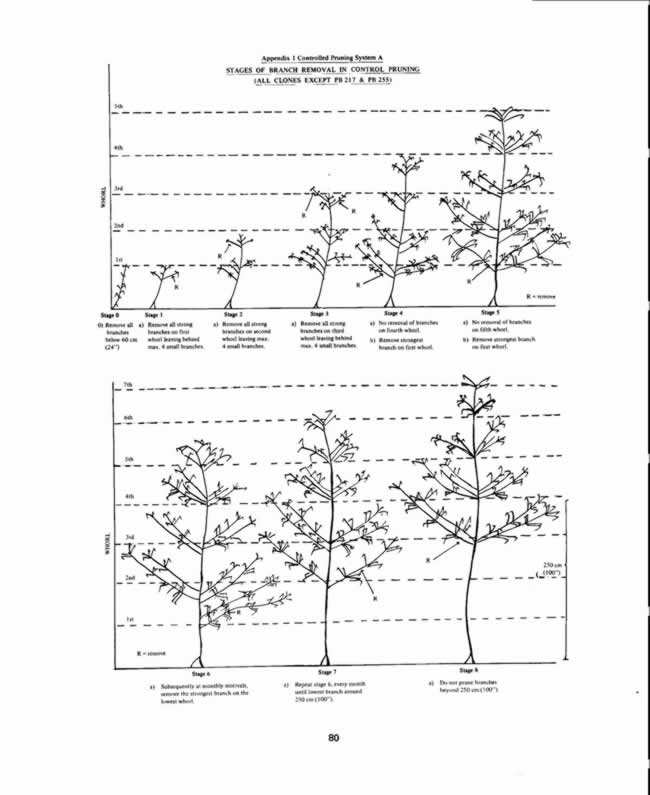
Enlarge Appendix 1 – Controlled Pruning System A

Enlarge Appendix 1 – Controlled Pruning System B
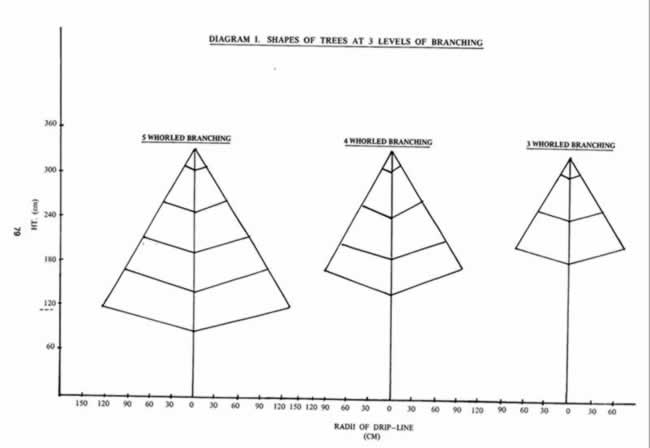
Enlarge Diagram 1 – Shapes of trees at three levels of branching
Contributor : Chan Weng Hoong
Rubber: Pests and Diseases
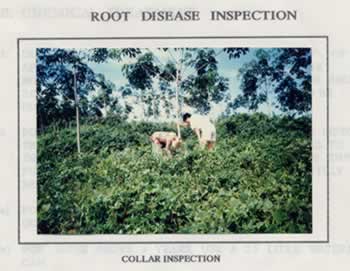
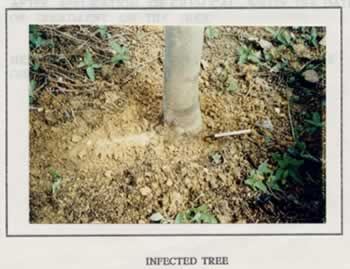
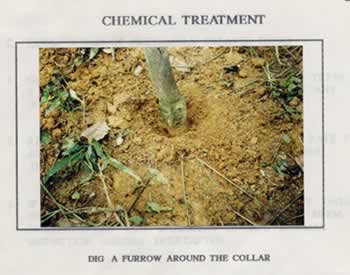
Control of White Root Disease in Immature rubber with 3 systemic fungicides.

Contributor : Chan Weng Hoong
Rubber: Manuring
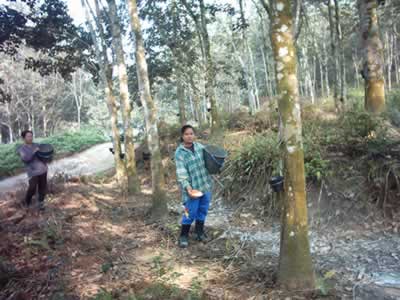
Manuring in rubber: need for re-evaluation based on case study.
Contributor : Chan Weng Hoong
Rubber: Selection of Clones
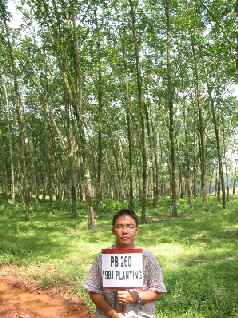
Performance of Clone PB260 in a large plantation group in Peninsular Malaysia.
Contributor : Chan Weng Hoong
Rubber: Exploitation
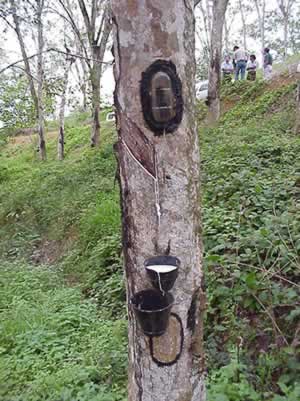
AAR jacket system: A Promising Improved System of extracting latex from rubber trees.
Evaluation of three types of rainguards.
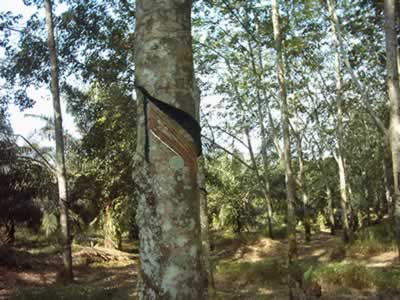
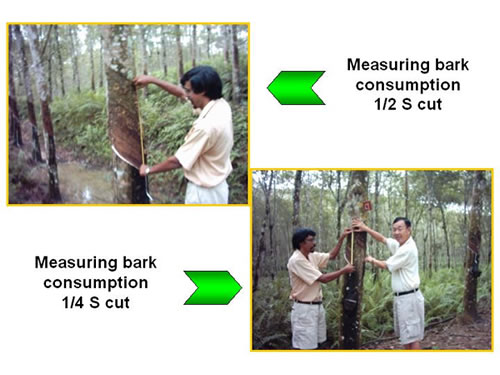
Use of Short Cuts to extend Lifespan of PB 260.
 .
.
Contributor : Chan Weng Hoong
Rubber: Rubber Outlook
|
Interest in rubber has recently resurfaced due to the increase in price of the commodity. Price of rubber has risen from RM3.50 per kg in 2002 to RM8.00 in 2006. Rubber price has been predicted to remain at current equitable prices for a while due to the following :
In view of the above, the Company has considered returning to rubber where terrain is steep and rainfall low where oil palm has not yielded well. |
 |
|
Past and current research interests are :
|
|
|
|
|
|
Contributor : Chan Weng Hoong |
|
Nutrition: Conclusions
[addw2p name=”oilPalmNutrition”]
The annual B requirement of oil palm increases rapidly and reaches a peak at six years after planting. B is mainly needed for the canopy development and fresh fruit bunch production. Majority of the absorbed B is phloem immobile but there is an indication that B in the petiole and rachis of old leaf is phloem mobile. By the time of replanting, B immobilized in the stem is sufficient to meet B requirement of oil palm in its first four years of growth and production. A management strategy is therefore required to recycle this substantial amount of B to the next generation of oil palm.
Nutrition: Discussion
[addw2p name=”oilPalmNutrition”]
The B requirement of oil palm in the first 82 months after planting was mainly driven by its growth rate, a process termed as growth demand for nutrients by Tinker and Nye (2000). This is due to the relatively constant B concentration across palm age in each palm component, which is in agreement with the results of Ng et al. (1968). However, the current Tenera oil palm on infertile Oxisols requires about 27 % more B than the older Dura planting material on fertile Inceptisols. This difference might be attributed to the larger canopy of the Tenera oil palm which is responsive to high fertilizer regime (Goh et al ., 2003).
The B content of the roots had not been studied in the oil palm. Initially it partitions a large proportion of its biomass to the roots to maximize the exploitation of soil water and nutrients. This results in relatively large B requirement for root development. But as the other vegetative matter develop and production commences, the proportion of B for roots declines to less than 6 % (Figure 1).
The annual B requirement decreased from the sixth year after planting due mainly to the declining growth rate of the stem (Figure 1). Extrapolating the model for the annual B requirement shows that the steady-state B uptake of 198 g ha-1 yr-1 as estimated using the 16 years old palms in the second experiment would be reached at the twelfth year after planting. This corresponds with the findings of Gerritsma and Soebagyo (1999). They found that the vegetative growth of oil palm reached its maximum at the twelfth year after planting, and FFB yields were relatively stable thereafter. Therefore, the nutrient requirements including B can be anticipated to be in a steady state too.
The Tenera fresh fruit bunches contained 2.39 mg B kg-1 which was only 12 % greater than Dura bunches reported by Ng et al. (1968). This was despite its bigger mesocarp and thinner shell and the former containing more B. This lack of difference could be partially attributed to the higher B concentrations in the stalk and empty spikelets of Dura bunches although strong conclusion could not be made since Ng et al . (1968) analyzed only two bunches compared with 26 bunches in this study.
The B distribution in the vegetative components and FFB of oil palm suggests that B is mainly transported by the xylem. In the oil palm, B is considered to be phloem immobile based on the work of Rajaratnam (1972). Moreover, B toxicity symptoms of oil palm are exhibited first in the tips and margins of leaflets of older leaves suggesting that it is a non-polyol producing plant (Brown et al ., 1999) and therefore, its B has restricted phloem mobility. However, a detailed analysis of the B concentrations in the canopy implies that B may be translocated in the phloem also. The young developing (spear) leaves had B concentration similar to the matured leaves (leaves 9 to 16) and higher than the maturing leaves (leaves 1 to 8). But the older leaves (leaf 33 and older) tended to have the lowest B concentration (Table 5). The declines in B concentration occurred in the petiole and rachis but not the leaflets (Table 6). This indicates that B may be mobile in the phloem of petiole and rachis only. Both Ng et al . (1968) and Rajaratnam (1972) did not investigate the B concentrations in the spear leaves and leaves older than 33. Thus, they did not observe the above and the latter concluded that B was phloem immobile while the former contended that there was no consistent trend. Rajaratnam (1972) further illustrated that B could be lost from the leaves through guttation in order to explain the differences in B contents in the leaves at different time of sampling and leaf age. However, this postulation could not explain our results since guttation can occur in all the leaves.
The oil palm is mainly planted on highly weathered Ultisols and Oxisols with generally low soil B content. Thus, increasing rates of soluble B fertilizer in the first six years after planting are usually required to match the annual B requirements (Figure 1). Apart from the first year, the B rates should range between 2.25 and 4.5 kg B ha-1 yr-1 due to the low fertilizer use efficiency of less than 15 % as obtained in this study. Subsequently, the B rates may be decreased to between 2 and 3 kg B ha-1 yr-1 for palms between seven and twelve years old. At the steady state of 12 years or older, only occasional B applications are probably necessary since B exported out of the system through FFB and immobilized in the stem is relatively low.
About 43 % of the B in FFB is found in the stalk and empty spikelets which can be returned to the fields via empty fruit bunches. It is probably also worthwhile to build-up B in the oil palm canopy in the early years to increase the B content in the leaf pile, which is the dominant source of organic matter in the plantations. This is because organic matter can be an effective source of B by mineralization when the soil B is low (Bell et al ., 2002).
The oil palm accumulates substantial B in its vegetative components and by the time of replanting at 25 years old, it should reach about 750 g B ha-1. This is sufficient to meet the B requirements of oil palm in the first four years. The current zero-burn replanting technique where the palms are felled, chipped and pulzerized, and the organic residues spread throughout the field may be able to return the palm B to the soils although the next generation of oil palms may not be able to exploit it fully due to its initial small root system and the large leaching loss of B in Malaysian soils (Rajaratnam, 1973b).