
Conferences/Seminars/Workshops (Internal)
Seminar
AAR Internal Training on Use of Garmin Navigator for KLK Assistant Managers
Date :27-30 Aug 2012
Venue : AAR Main Office, Kota Damansara
AAR Internal Training on Rubber Agronomy
Date :11-14 Apr 2011
Venue : AAR Main Office, Sg. Buloh & Selborne Estate, Kuala Lipis, Pahang
Oil Palm Nursery Training
Date :5-7 April 2011
Venue : Fraser Estate Club House & Nursery
Pest and Disease Training
Date :22-23 Mar 2011
Venue : LPF Estate, Perak
AA Hybrida 1 Seminar
Date :15-16 Nov 2010
Venue : AAR Paloh, Johor
AAR Internal Rubber Agronomy Training
Date :15-19 Mar 2010
Venue : AAR Main Office, Sg. Buloh & Sg. Kawang Estate, Pahang
Leaf and Soil Sampling on Rubber Training
Date :3-4 Mar 2010
Venue : AAR Main Office, Sg. Buloh
AAR Internal Soil Correlation Tour
Date :1-4 Feb 2010
Venue : LPF Estate, Perak
Introductory Training Course to AAR R&D Agronomists
Date :16-19 Nov 2009
Venue : AAR Main Office, Sg. Buloh & Changkat Asa Estate, Perak & Tuan Mee Estate, Selangor
Seminar and Field Day on Pests and Diseases Management
Date :3 Feb 2009
Venue : AAR Paloh, Johor
Agronomy and Statistics Training
Date :1-4 Dec 2008
Venue : Tawau & Lahad Datu, Sabah
AAR Annual Seminar and Officers’ Training
Date :03-06 Dec 2007
Venue : Legend Resort Cherating, Pahang & Ketengah Pewira & Yit Tengah Estate, Terengganu
Field Day on AA Oil Palm Planting Materials & Nursery Demonstration
Date :13 Oct 2003
Venue : Paloh Estate, Johor
AAR Field Day Programme for BEA Sabah & Sarawak Estates’ manager in KK
Date :08 Jul 2000
Venue : Kota Kinabalu, Sabah
AAR Field Day for BEA estate managers
Date :16 May 2000
Venue : AAR Main Office, Sg. Buloh
AAR Field Day for Manager
Date :25 Jan 2000
Venue : AAR Main Office, Sg. Buloh & Coalfield, Selangor
AAR Seminar in Sabah
Date :27 Aug 1996
Venue : Sri Kunak Estate, Sabah
AAR Field Day 1993
Date :23 Aug 1993
Venue : Balau Estate, Selangor
1990 Oil Palm Field Day
Date :20 Dec 1990
Venue : Tuan Mee Estate, Selangor
Taiko Seminar & Field Day
Date :17 Jan 1989
Venue : –
Modelling the Oil Palm Growth and Its Microclimate Environment
The oil palm has been grown commercially for nearly a century and yet little is known about the impact of its canopy architecture on its growth and yield, and microclimate environment. This information is useful in breeding for the ideal palms in relation to the planting density and pattern to maximize productivity. Changing the canopy architecture may lead to easier harvesting, which is currently a major problem in oil palm management, and may lend itself to feasible mechanization. However, the first step coordinator is Dr. Christopher Teh, University Putra Malaysia team members from Malaysian Palm Oil Board and Advanced Agriecological Research S/B.
Some early results are presented in conferences e.g.
|
Teh, C.B.S., Henson, I.E., Goh K.J.and Husni, M.H.A. 2004 . The effect of leaf shape on solar radiation interception. In: Shamsuddin, Z. et al. (Eds.) Agriculture Congress: Innovation towards modernized agriculture (2004 Sri Kembangan). Book of Absracts of AGRICONGRESS 2004, Malaysia International Exhibition and Convention Centre(MIECC), Selangor, Malaysia, Oct. 4-7, 2004: 145-147.
|
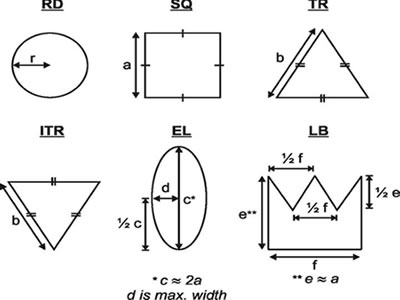
Which leaf shapes intercept the most solar radiation? Leaf shapes for the six plant prototypes: round (RD), square (SQ), triangle (TR), inverted triangle (ITR), ellipse (EL) and lobe (LB)
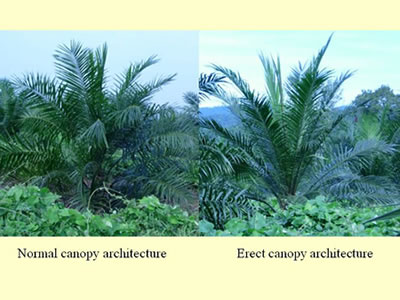
Which canopy architectures intercept more solar radiation?
|
|
Teh, C.B.S., Henson, I.E., Harun, H., Goh K.J. and Husni, M.H.A. (2005). Modelling oil palm growth and yield. In: Teh, C.B.S., Ahmad, O.H., Fauziah, C.I., Izham, A., Wan Noordin, W.D. & Zakaria, Z.Z. (Eds.) Soils 2005: Advanced in Soil Science for Sustainable Food Production, Malaysian Soil Science Society, Kuala Lumpur: 204-206.
|
|
| Teh, C.B.S., Henson, I.E., Harun, H., Goh K.J.and Husni, M.H.A. (2005). Do not reinvent the wheel: Extending the life span of agriculture models. In: Cebci, Z., Sideridis, A., Say, S.M. & Darcan, N. (Eds.) International Congress On Information Technology In agriculture, Food & Environment (ITAFE 2005), Cukunova University: 550-556. |
Greenhouse Gas Fluxes from Tropical Peatland and Global Warming Potential
-
To quantify the amount of soil CO2 fluc under the forest, sago and oil palm ecosystems and to determine the underlying environmental factors related to soil respiration.
-
To quantify the amount of CH4 flux under the forest, sago and oil palm ecosystems and to determine the underlying environmental factors that explain the differences in CH4 flux among the three ecosystems, particularly the effects of drainage and compaction.
-
To quantitatively determine the rates of N2O emissions from the forest, sago and oil palm ecosystems and to characterize the variations in N2O emissions and relate them to the environmental parameters that control N2O exchange between the soil and the atmosphere.
-
To quantify the effect of urea under oil palm ecosystem on the seasonal CH4 variation and to determine the environmental factors controlling it.
-
To estimate the relative contribution of the individual GHGs under forest, sago and oil palm ecosystems to the net global warming potential (GWP) of the three ecosystems on tropical peatland.
Some major results are:
| Tropical peatlands function as a significant source of atmospheric CO2on a global scale. |
Dry season in peatland (photo)
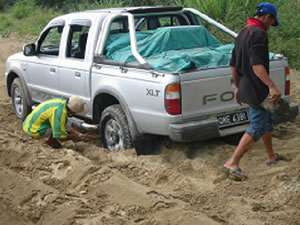 Wet season in peatland (photo) Wet season in peatland (photo) |
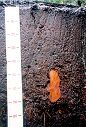
Peat profile
 |
| Soil respiration rate was highest in forest ecosystem on tropical peatland compared to oil palm and sago ecosystems. | ||
| The oil palm and forest ecosystems on tropical peatland behaved like aerobic system in most months whereas the sago ecosystem remained mainly anaerobic throughout the year. Thus, different factors regulated the activity of greenhouse gases in each ecosystem. | ||
|
IMPHOS Project: Phosphate Fertiliser Management in Oil Palm Plantation in Malaysia
Phosphate deficiencies is a major factor in declining crop production in many acidic soils in developing countries in the tropics, where the soils are either inherently low in soil P or they are present in forms that are unavailable to plants. These conditions are found in Malaysian soils where oil palms are extensively cultivated. Recent work has shown that phosphate rocks with the right chemical and physical properties can be effective P sources for oil palm if various agronomic factors e.g. sufficient organic matter and living green manure, adequate rainfall and appropriate management are in place. The primary project objectives are:
- To evaluate suitable and cost effective P fertiliser sources for oil palms grown on different soil types and ecological zones in Malaysia
- To study the management practices for P fertiliser application to increase P use efficiency
- To study the effects of organic residue amendments and management (legume covers, empty fruit bunches, cut fronds and palm oil mill effluent) on P fertiliser use by oil palm
- To evaluate methods of fertilizer and soil P analysis and correlate with P uptake and yield of oil palm
- To measure residual P availability in relation to soil P fractions, leaf P content and fresh fruit bunch (FFB) yield
- To study the soil P pools and processes affecting PR dissolution and P availability

Briefing on trial progress and results by Patrick Ng, AAR, at Batu Lintang estate, Kedah. (From left to right (clockwise)): Lee chin Tui (Felda), Ilangovan, K. (Felda), Assoc. Prof. Dr. Mohd. Hanafi Musa (UPM), Teo Chor Boo (AAR), Chang Ah Kow (Tradewinds), Nga Shee Kiong (Felda), Dr. Zulkifli Hashim (MPOB), Shaharudin Bakar (Golden Hope), Prof. Dr. Zaharah Abdul Rahman (UPM) and Patrick Ng (AAR).
Some early results are:
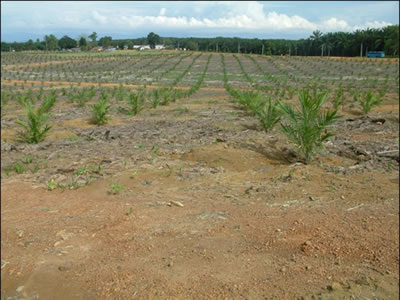
| P concentrations of Mucuna bracteata(MB) responded linearly to phosphate rock up to 97 kg P ha-1 whereas no significant response was obtained for Pueraria javanica (PJ). |
One month after planting the oil palm
 13 months after planting the oil palm
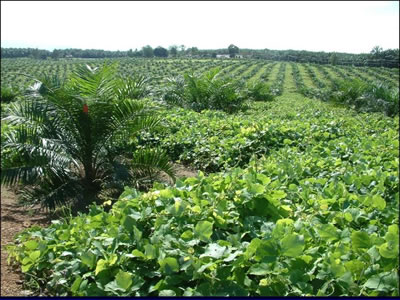 |
| MB planted with PJ showed significantly higher mean P concentration of 0.141% compared with pure MB of 0.117%. | |
| This symbiotic effect might be attributed to the rapid ground coverage of PJ which would reduce erosion and run-off losses of applied PR and solubilize PR with consequent higher P availability to MB. | |
| For further details, see Ng P.H.C., Goh K.J., Gan H.H. and Zaharah, A.B. (2005). Impact of phosphate rock on P uptake and dry matter production of mixed legumes under oil palm in Malaysia. In: Li, C.J. et al. (eds) In: Proc. XV International Plant Nutrition Colloquium on Plant Nutrition For Food Security, Human Health And Environmental Protection, Tsinghua University Press, Beijing, China: 1124-1125. |
AA DxP Oil Palm Seeds
|
SIRIM & MPOB Licensed Seeds AA DxP seeds and seedlings are licensed by SIRIM and MPOB. Superior Pedigree Seeds AA DxP seeds are produced from selected dura and pisifera parents derived from superior pedigrees, which are featured in the best DxP seeds produced locally and internationally. |
|
|
|
 |
 |
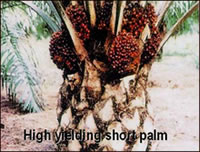
Ulu Remis Deli duras are known for their uniform high yield and good oil extraction characteristics. La Me and Dabou Deli duras have been selected for high bunch weight, good oil extraction and short stature. In the production of AA DxP seeds, attempts are made to combine the best attributes of these pedigrees to give rise to palms with high oil yield and a small palm stature, important attributes in our increasingly scarce and costly labour market.
|
 |
AA DxP pisifera parents inherit the high bunch yield characteristic of S27B, AVROS and Yangambi, the high oil extraction of AVROS and Yangambi and the short stature of the Dumpy and the Yangambi parents.
|
|
|
The next generation of AA pisiferas (Dy.Ybi.AVROS) will combine the best features of Dy.AVROS and Ybi.AVROS pisiferas.
|


Companies in AAR Advisory Services
Companies in AAR Advisory Services on 1 January 2010 include :
Peninsular Malaysia
Associated Land Sdn. Bhd.
Bank Pertanian Malaysia
Boustead Eldred Sdn. Bhd.
Boustead Heah Joo Seang Sdn. Bhd.
Boustead Holdings Bhd.
Boustead Plantations Bhd.
Boustead Plantations Bhd. & Felda Holdings Bhd.
Boustead Properties Bhd.
Boustead Rimba Nilai Sdn. Bhd.
Boustead Sedili Sdn. Bhd.
Boustead Sg. Manar Sdn. Bhd.
Boustead Silasuka Sdn. Bhd.
Boustead Solandra Sdn. Bhd.
Bukit Katho Estate Sdn. Bhd.
Bukit Kledek Development Sdn. Bhd.
Bukit Tebuan Estate Sdn. Bhd.
Clarity Crest Sdn. Bhd.
Desa Puchong Sdn. Bhd.
Gunong Pertanian Sdn. Bhd.
Kampar Rubber & Tin Co. Sdn Bhd.
KL-Kepong Bhd.
Ladang Gadek Development Sdn. Bhd.
Ladang Kupang Development Sdn. Bhd.
Ladang Perbadanan-Rima Bhd.
Ladang Pondoland
Malay Rubber Plantations (M) Sdn. Bhd.
Permodalan Pelangi Sdn. Bhd.
Revertex (M) Sdn. Bhd.
Semai Segar Sdn. Bhd.
Solandra Sdn. Bhd.
Tanah Semai Sdn. Bhd.
Tasek Plantations Sdn. Bhd.
The Shanghai Kelantan Rubber Estates
Tronoh Malay Oil Palm Sdn. Bhd.
UM Plantations Sdn. Bhd.
Uni-Agro Multi Plantations Sdn. Bhd.
Wan Hin Plantations Sdn. Bhd.
Wan Lee Estate Sdn. Bhd.
Wan Lim Plantations Sdn. Bhd.
Yayasan Perak-Wan Yuen Sdn. Bhd.
Sabah
Boustead Emastulin Sdn. Bhd.
Boustead Gradient Sdn. Bhd.
Boustead Rimba Nilai Sdn. Bhd.
Boustead Rimba Nilai Sdn. Bhd. & Boustead Trunkline Sdn. Bhd.
Boustead Segaria Sdn. Bhd.
Boustead Sutera Sdn. Bhd.
Golden Sphere Sdn. Bhd.
KL-Kepong (Sabah) Bhd.
Ladang Koko Sg. Limau Sdn. Bhd.
Ladang Tabung Haji (S) Sdn. Bhd.
Ladang Tabung Haji (Sabah & Sarawak) Sdn. Bhd.
Parit Perak Plantations Sdn. Bhd.
Perwira Plantations Sdn. Bhd.
Resort Corporation Sdn. Bhd.
Sabah Cocoa Sdn. Bhd.
Segamaha Development Sdn. Bhd.
Sarawak
Boustead Pelita Kanowit Sdn. Bhd.
Boustead Pelita Tinjar Sdn. Bhd.
Indonesia
PT Adei Plantation & Industry
PT Dendymarker Indah Lestari
PT Hujan Hijau Mas
PT Incasi Raya Group
PT Malindomas Perkebunan
PT Mulia Agro Permai
PT Steelindo Wahana Perkasa Sdn. Bhd.
Consultant
| Name | Current Position | Date Joined | Date Left |
|---|---|---|---|
| Professor P.Bernard Tinker (Dr.) | Consultant – Research & Administration | 07-1986 | 30-06-2011 |
| Jeremy Roberts (Mr.) | Consultant – BioTechnology | 01-2006 | 01-12-2006 |
| Liew Kon Wui (Dr.) | Consultant – R&D (Pests & Diseases) | 01-2006 | 01-01-2007 |
| Soh Aik Chin FAsc (Dr.) | Consultant – BioTechnology | 03-2007 | |
| Chan Weng Hoong (Mr.) | Consultant – Rubber & Oil Palm | 04-2009 | |
| Chew Poh Soon FIsp FMosta FMsss (Mr.) | Consultant – Research & Administration | 07-2011 |
Mr. Chew Poh Soon
 |
Mr. Chew Poh Soon FIsp, FMosta, FMsss
Contact Details : – Tel. : – |
||
|
AAR Board of Directors has recently appointed Mr. Chew Poh Soon as our Consultant with effect from 1 July 2011 to replace Prof. Dr. Bernard Tinker, who has retired after many years with us. Besides being familiar with the work and vision of AAR, (which he helped to setup and helmed it from 1986 until his retirement in 2000), Mr. Chew’s responsibilities will be threefold: 1) review/advise AAR ‘s overall research and development program We look forward to working closely, and to extend our fullest cooperation to him. For further details on his bio-data and achievements, we reproduced below an extract from The ISP’s interview with Mr. Chew Poh Soon, published in The Planter, January 2011 issue, Vol. 87, No. 1018, Page 45-54. To Mr. Chew Poh Soon, we extend our warmest welcome! |
|||
Mr. Chan Weng Hoong
 |
Mr. Chan Weng Hoong Contact Details : Tel. : 6-03-61561152 |
||||||
|
|||||||