
Oil Palm: Plant Breeding
Oil Palm Genetic Improvement
Introduction
Germplasm Resources
Improvement Objectives
Breeding Techniques
Future Prospects
A. Origins
The African oil palm (Elaeis guineensis Jacq.), which is the oil palm of commerce, is endemic to tropical Africa stretching from the Atlantic coast (Guinea) in the west to Zanzibar and the island of Madagascar in the east and from the sub-Sahara in the north (Senegal, 16 °N) to the south of Angola (15 °S) bordering Namibia (Hartley 1988; Latiff 2000). The center of origin and diversity appears to be concentrated in the tropical rain forests of west and central Africa (Angola, Cameroon, Congo, Ghana, Ivory Coast, Nigeria and Zaire). They occur naturally as semi-wild groves in swamps and riverine forest fringe areas in the plains usually close to settlements but are also found on drier and higher grounds up to the altitude of 1500 m above sea level. The American oil palm (Elaeis oleifera) which also produces an oil in smaller quantities consumed by the natives and is of interest in breeding because of some of its desirable attributes, however, is endemic to tropical Latin America stretching from Mexico in the north to the Amazonas of Bolivia, Brazil, Colombia and Peru in the south and straddling the Pacific and Atlantic coasts. They also occur naturally in groves in open grasslands and riverine areas and their distribution appears to be associated with indigenous Indian migratory movements (Santos et al. 1986). The distribution of the groves tended to be more discontinuous.
The genus Elaeis, which belongs to the Cocoideae subfamily of the Palmaceae, has an American or African center of origin. The two oil palm species were presumed to have diverged when the American and African continents drifted apart in prehistoric times (Zeven 1965). There are two lesser-known species of Elaeis: E. odora (South America) and E. madascariensis (Africa).
B. Crop status
Crude palm oil extracted traditionally from the fruit pulp of the semi-wild oil palms was the source of dietary fat and certain vitamins (A and E) of the indigenous populations of tropical Africa and America. Interest in the oil palm as a crop arose as a substitute for animal fat in the manufacture of soap, candle wax and margarine. Plantations were started in the East Indies (Indonesia, Malaysia) by the European colonists to ensure a steady supply of the raw material (Hartley 1988). Two seedlings each from the botanic gardens of Amsterdam and Mauritius, the thick-shelled or dura form (Plate 1A) derived presumably from the same palm in West Africa, were taken and grown in the Bogor Botanic Gardens, Java, Indonesia in 1848. With the expanding interest in the crop, subsequent hybridizations and selections were made from these four Bogor palms and the progenies distributed to the Deli province in Sumatra and thence Malaysia (Malaya then) to become known as the Deli dura population (Rosenquist 1986). This uniform high oil yielding Deli dura was the commercial planting material for the rapidly expanding plantations in the Far East from 1911 till the early 1960s. With the revelation of monogenic inheritance of the shell gene by Beirnaert and Vanderweyen (1941) and that the hybrid progenies of the thick-shelled dura and the shell-less female sterile pisifera are 100% thin-shelled teneras having thick-mesocarp and thence higher oil yield (Plate 1A), the change to the tenera hybrid planting material was very rapid as teneras from West Africa had been imported and bred earlier by researchers in the Far East and they became the source of the pisiferas (Hartley 1988).

Plate I. A) Thick shelled dura (D), shell-less pisifera (P), and thin shelled hybrid tenera (T) fruits of oil palm
The oil palm is the second most important oil crop next to soybean and is poised to become the dominant oil crop early in the new decade (Mielke 2000; Yusof and Mohd Arif 2000). Palm oil constitutes 19% of the world’s oils and fats production and is the dominant oil of international trade. The oil is produced from about 6 million hectares of plantations in the countries of the humid tropics i.e. Colombia, Indonesia, Ivory Coast, Malaysia, Nigeria, Thailand, with Malaysia accounting for 48% and Indonesia 31% of production. With the rapid expansion of the world population particularly in the third world countries where dietary fat intake is still very low, per capita oil and fat consumption is likely to increase tremendously and the oil palm being the most productive and profitable oil crop will continue to expand in its cultivation to meet this demand.
C. Uses
The oil palm fruit bunch produces two types of oil, “palm oil” from the mesocarp (20%) and “palm kernel oil” from the kernel (3%). Crude palm oil extracted from the sterilized mesocarp is refined, bleached from its original orange-red color, and deodorized to give refined palm oil used solely or blended with other oils in cooking oil, salad oil, margarines and spreads. The refined oil is fractionated to give olein and stearin and with further fractionation gives fatty acids and alcohols, intermediate commodities traded and used in food and oleochemical industries. Palm oil can be used as a biofuel as with other vegetable oils. About 80% of palm oil, however, is used in the food industries although its other uses are increasing. Palm kernel oil is a competitor for coconut oil and has more uses in the oleochemical industries. Fig.1 is a summary chart of the fractionated products and their uses.

Enlarge Fig. 1: Uses of palm oil
Secondary and waste products from the palm oil industry are assuming economic importance prompted largely by health and environmental concerns. Carotene from the crude palm oil can be processed into Vitamin A supplement and a natural dye for snack foods e.g. instant noodles. Likewise, tocopherols and tocotrienols can be extracted from palm oil for industrial Vitamin E production (Choo 2000; Jalani et al. 1997). Kernel cake and sludge cake, wastes from the palm and kernel oil extraction processes, respectively have use as animal feed while the fruit bunch stalk fiber waste can be used directly in the plantation as an organic mulch or processed into an organic compost.
Reference
Soh, A.C., Wong, G., Hor, T.Y., Tan, C.C. and Chew, P.S. 2003. Oil palm genetic improvement. In: Janick, J. (ed.). Plant Breeding Reviews Vol. 22. John Wiley & Sons, New Jersey, pp. 165-219
Note: The full list of references quoted in this article is available from the above paper.
Introduction to Agro-management
In Southeast Asia, plantation tree crops comprise mainly oil palm (Elaeis guineensis), rubber (Hevea brasiliensis) and cocoa (Theobroma cacao). Their management by large plantation companies has always been based on scientific principles and results, and the old adage taken from Sanskrit, the classical, literary language developed from about 1500 B.C. by the Hindus in Northern India (Johnson, 1995):
“Upon this handful of soil our survival depends. Husband it and it will grow our food, our fuel and our shelter and surround us with beauty. Abuse it and the soil will collapse and die taking man with it”.
In Malaysia, field experimentation on plant breeding and agronomic requirements of oil palm commenced in the 1920s but intensive research only took off from the late 1960s coinciding with the increased interest in oil palm as an alternative crop to rubber. This was in line with the country crop diversification programme in the early 1970s. Research on the cultivation of rubber has a longer history but unfortunately, interest in the crop started to wane from the late 1980s resulting in a sharp decline in research activities in Malaysia. Although the current rubber prices make it an attractive second perennial crop and commonly more profitable than oil palm on marginal soils, they came a tinge too late as most areas have been converted to oil palm. However, if the current prices and prospect continue to be good, it might be worthwhile to seriously consider replanting oil palms on existing marginal and unsuitable soils with rubber, if it is more profitable. Cocoa, a once potential plantation tree crop was debilitated by low soil pH, vascular streak dieback and cocoa pod borer apart from unsubstantiated and unproven cultivation techniques for the locality. It is now just a smallholder crop in much of Southeast Asia. Coconut has always been largely a smallholder crop or a shade tree for cocoa although some plantations have been planting the newer, high yielding variety called MATAG.
Traditionally, successful tree crop cultivation requires matching crops to soils, maintaining if not improving soil fertility, understanding the crop habit and management requirement, adapting technology to changing scenarios particularly labour and the environment, control of production cost and business consideration including marketing. However, in today’s ideology, crop production research and management is insufficient to sustain the crop. We need to consider transparency, traceability, ecology, environment and social responsibility in the sustainability of a crop. Perhaps, we could modernise the adage from Sankrit by simply changing the word “soil” to “environment”, although it is yet to be proven and substantiated to be most relevant to agriculture in particular when it is way beyond the boundary of agricultural land, and most of all, it is yet to be understood.
We shall start off this write-up with the management of oil palm, the largest plantation tree crops in the World. However, this website presents only our views and published work on the best agro-management practices for tree crop plantations. Those interested in the details should refer to the following books:
-
The oil palm by Corley and Tinker,
-
Rubber by Webster and Baulkwill, and
-
Cocoa by Wood and Lass
-
Coconut by Ohler
We shall appreciate your views, comments and suggestions on the topics and papers presented here.
Reference
Corley, R.H.V. and Tinker, P.B. (2003) The Oil Palm. 4 th Edition, Blackwell Science Ltd., England: 562 pp.
Ohler, J.G. (1999) Modern Coconut Management: Palm Cultivation and Products. The Food and Agriculture Organisation (FAO) and Universiteit Leiden, Intermediate Technology Publications, England: 458 pp.
Johnston, A.E. (1995). The Sustainability and Increase of Agricultural Productivity, the Current Dilemma. In: 24th IPI Colloquium, Chiang Mai, Thailand: Preprint.
Webster, C.C. and Baulkwill, W.J. (1989) Rubber. Tropical Agricultural Series, Longman Scientific and Technical, England: 614 pp.
Wood, G.A.R. and Lass, R.A. (1985) Cocoa. 4 th Edition, Tropical Agricultural Series, Longman Group Ltd., England: 620 pp.
Contributor
Goh, K.J.
AAR Newsletters
 |
|
 |
|
 |
|
 |
|
 |
|
 |
|
 |
|
 |
|
 |
|
 |
|
 |
|
 |
|
 |
|
 |
|
 |
|
 |
|
 |
|
 |
|
 |
|
 |
|
 |
|
 |
|
 |
|
 |
|
 |
|
 |
|
 |
|
 |
|
 |
|
 |
|
 |
|
 |
|
 |
|
 |
|
 |
|
 |
|
 |
|
 |
|
 |
|
 |
|
 |
|
 |
|
 |
|
 |
|
 |
|
 |
|
 |
|
 |
|
 |
|
 |
|
 |
|
 |
|
 |
|
 |
|
 |
|
 |
|
 |
|
 |
|
 |
|
 |
|
 |
|
 |
|
 |
|
 |
|
 |
|
 |
|
AAR Events
- AAR MEOA Seminar 2015 (21 January 2015)
- KLK Mini-Conference 2014 (24 – 26 February 2014)
- AAR Chinese New Year Celebration (13 Feb 2014)
- AAR Annual Dinner (8 Nov 2013)
- AAR Desaru Team Building Trip (6 – 8 Sep 2013)
- AAR Raya Celebration (29 Aug 2013)
- AAR Seminar on Hybrida (27 Jun 2013)
- Natsem Exhibition (24 – 26 Jun 2013)
- AAR Sports Day (16 Mar 2013 & 18 May 2013)
- AAR Bukit Broga Trip (4 April 2013)
- AAR Annual Dinner 2012 (7 December 2012)
- AAR Annual Trip to Redang Island 2012 (29 June – 1 July 2012)
- AAR Annual Dinner – 25th Anniversary (2 December 2011)
- AAR Durian Feast (19 July 2011)
- AAR Sports Club Trip to Port Dickson (18-19 June 2011)
- Annual AARSB Sports Club Hi Tea (27 November 2010)
- Majlis SIRIM – Industri 2010 (19 November 2010)
- AAR Durian Feast (1 August 2010)
- AAR Sports Club Trip to Langkawi Island (15-18 July 2010)
- Celebrating an important milestone (17 April 2010)
- Urban Party High Tea @ Atrium Cafe, Sunway Pyramid (7 November 2009)
- Sabah Annual Dinner and Raya Celebration (1-2 November 2009)
- Sabah AAR Sports/Family Day (25 October 2009)
- AAR Advisory Team Gunung Ledang Challenge (9-11 October 2009)
- Official Opening of AAR-UNMC Biotechnology Research Centre (29 September 2009)
- AAR Sports Club Family Day cum Trip to Malacca & AFamosa (25-26 July 2009)
- AAR Durian Fest (3 July 2009)
- AAR Tissue Culture Sports Day (16 June 2009)
- Sabah Substation Adventure to Borneo Paradise Eco Farm Resort (6-7 June 2009)
- Bowling Tournament (23 May 2009)
- AAR Team Building at Mount Kinabalu, Sabah (21-24 April 2009)
- In-house Training on Agronomy and Statistics (1-4 December 2008 at Tawau & Lahad Datu, Sabah)
- AAR Sports Club Dinner (29 November 2008)
- AAR Substation Paloh Netball Tournament (23 August 2008)
- AAR Sports Club Family Day (2 August 2008)
- Sabah Substation Trip to Orang Utan Rehabilitation Centre (2-3 August 2008)
- AAR Sports Club Trip to Tambun and Cameron Highlands (11-12 July 2008)
- AAR Durian Fest (4 July 2008)
- Official Opening of AAR Tissue Culture Laboratory (17 January 2008)
- AAR Annual Dinner 2007 (24 November 2007)
- AAR Sports Club Trip to Tioman Island (3-5 August 2007)
- Setting and Working with Effective KPIs (Key Performance Indicators)
- Dr. Soh’s Farewell Dinner (4 February 2007)
- AAR Annual Dinner 2006 (25 November 2006)
- Dr. Tinker’s Consultancy Visit 2006 (28 June 2006 – 5 July 2006)
- AAR Annual Dinner 2005 (10 December 2005)
Refreshed AAR Website
AAR’s website has been refreshed with new look!
AAR News
Conferences/Seminars/Workshops (External)
Palm and Lauric Oils Conference (POC) 2013
Date : 4-6 March 2013
Venue : Shangri-la Hotel, Kuala Lumpur, Malaysia
Malaysian Society of Soil Science Conference (MSSS) SOILS 2013
Date : 9-11 April 2013
Venue : Bukit Gambang Resort City, Bukit Gambang, Pahang, Malaysia
World Biotechnology Congress 2013
Date : 3-6 June 2013
Venue : John B. Hynes Vetrrans Memorial Convention Center, Boston
International Conference on Environmental Science and Technology (ICEST 2013)
Date : 18-21 June 2013
Venue : Urgup, Nevsehir, Turkey
10th ISP National Seminar (NATSEM) 2013
Date : 24-26 June 2013
Venue : Kingwood Hotel, Sibu, Sarawak, Malaysia
ICABBBE 2013 : International Conference on Agricultural, Biotechnology, Biological and Biosystems Engineering
Date : 30-31 July 2013
Venue : Zurich, Switzerland
10th International Congress of Plant Pathology 2013
Date : 25-30 August 2013
Venue : Beijing, China
International Palm Oil Congress (PIPOC) 2013
Date : 19-21 November 2013
Venue : Kuala Lumpur Convention Centre, Kuala Lumpur, Malaysia
19th Australasian Plant Pathology Conference 2013
Date : 25-18 November 2013
Venue : Aucland, New Zealand
Conferences/Seminars/Workshops (Internal)
Seminar
AAR Internal Training on Use of Garmin Navigator for KLK Assistant Managers
Date :27-30 Aug 2012
Venue : AAR Main Office, Kota Damansara
AAR Internal Training on Rubber Agronomy
Date :11-14 Apr 2011
Venue : AAR Main Office, Sg. Buloh & Selborne Estate, Kuala Lipis, Pahang
Oil Palm Nursery Training
Date :5-7 April 2011
Venue : Fraser Estate Club House & Nursery
Pest and Disease Training
Date :22-23 Mar 2011
Venue : LPF Estate, Perak
AA Hybrida 1 Seminar
Date :15-16 Nov 2010
Venue : AAR Paloh, Johor
AAR Internal Rubber Agronomy Training
Date :15-19 Mar 2010
Venue : AAR Main Office, Sg. Buloh & Sg. Kawang Estate, Pahang
Leaf and Soil Sampling on Rubber Training
Date :3-4 Mar 2010
Venue : AAR Main Office, Sg. Buloh
AAR Internal Soil Correlation Tour
Date :1-4 Feb 2010
Venue : LPF Estate, Perak
Introductory Training Course to AAR R&D Agronomists
Date :16-19 Nov 2009
Venue : AAR Main Office, Sg. Buloh & Changkat Asa Estate, Perak & Tuan Mee Estate, Selangor
Seminar and Field Day on Pests and Diseases Management
Date :3 Feb 2009
Venue : AAR Paloh, Johor
Agronomy and Statistics Training
Date :1-4 Dec 2008
Venue : Tawau & Lahad Datu, Sabah
AAR Annual Seminar and Officers’ Training
Date :03-06 Dec 2007
Venue : Legend Resort Cherating, Pahang & Ketengah Pewira & Yit Tengah Estate, Terengganu
Field Day on AA Oil Palm Planting Materials & Nursery Demonstration
Date :13 Oct 2003
Venue : Paloh Estate, Johor
AAR Field Day Programme for BEA Sabah & Sarawak Estates’ manager in KK
Date :08 Jul 2000
Venue : Kota Kinabalu, Sabah
AAR Field Day for BEA estate managers
Date :16 May 2000
Venue : AAR Main Office, Sg. Buloh
AAR Field Day for Manager
Date :25 Jan 2000
Venue : AAR Main Office, Sg. Buloh & Coalfield, Selangor
AAR Seminar in Sabah
Date :27 Aug 1996
Venue : Sri Kunak Estate, Sabah
AAR Field Day 1993
Date :23 Aug 1993
Venue : Balau Estate, Selangor
1990 Oil Palm Field Day
Date :20 Dec 1990
Venue : Tuan Mee Estate, Selangor
Taiko Seminar & Field Day
Date :17 Jan 1989
Venue : –
Modelling the Oil Palm Growth and Its Microclimate Environment
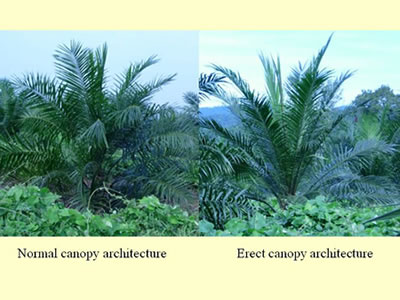
The oil palm has been grown commercially for nearly a century and yet little is known about the impact of its canopy architecture on its growth and yield, and microclimate environment. This information is useful in breeding for the ideal palms in relation to the planting density and pattern to maximize productivity. Changing the canopy architecture may lead to easier harvesting, which is currently a major problem in oil palm management, and may lend itself to feasible mechanization. However, the first step coordinator is Dr. Christopher Teh, University Putra Malaysia team members from Malaysian Palm Oil Board and Advanced Agriecological Research S/B.
Some early results are presented in conferences e.g.
|
Teh, C.B.S., Henson, I.E., Goh K.J.and Husni, M.H.A. 2004 . The effect of leaf shape on solar radiation interception. In: Shamsuddin, Z. et al. (Eds.) Agriculture Congress: Innovation towards modernized agriculture (2004 Sri Kembangan). Book of Absracts of AGRICONGRESS 2004, Malaysia International Exhibition and Convention Centre(MIECC), Selangor, Malaysia, Oct. 4-7, 2004: 145-147.
|
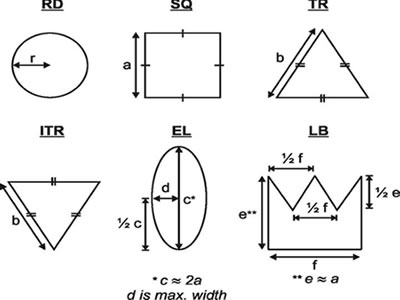
Which leaf shapes intercept the most solar radiation? Leaf shapes for the six plant prototypes: round (RD), square (SQ), triangle (TR), inverted triangle (ITR), ellipse (EL) and lobe (LB)
Which canopy architectures intercept more solar radiation?
|
|
Teh, C.B.S., Henson, I.E., Harun, H., Goh K.J. and Husni, M.H.A. (2005). Modelling oil palm growth and yield. In: Teh, C.B.S., Ahmad, O.H., Fauziah, C.I., Izham, A., Wan Noordin, W.D. & Zakaria, Z.Z. (Eds.) Soils 2005: Advanced in Soil Science for Sustainable Food Production, Malaysian Soil Science Society, Kuala Lumpur: 204-206.
|
|
| Teh, C.B.S., Henson, I.E., Harun, H., Goh K.J.and Husni, M.H.A. (2005). Do not reinvent the wheel: Extending the life span of agriculture models. In: Cebci, Z., Sideridis, A., Say, S.M. & Darcan, N. (Eds.) International Congress On Information Technology In agriculture, Food & Environment (ITAFE 2005), Cukunova University: 550-556. |
Greenhouse Gas Fluxes from Tropical Peatland and Global Warming Potential
-
To quantify the amount of soil CO2 fluc under the forest, sago and oil palm ecosystems and to determine the underlying environmental factors related to soil respiration.
-
To quantify the amount of CH4 flux under the forest, sago and oil palm ecosystems and to determine the underlying environmental factors that explain the differences in CH4 flux among the three ecosystems, particularly the effects of drainage and compaction.
-
To quantitatively determine the rates of N2O emissions from the forest, sago and oil palm ecosystems and to characterize the variations in N2O emissions and relate them to the environmental parameters that control N2O exchange between the soil and the atmosphere.
-
To quantify the effect of urea under oil palm ecosystem on the seasonal CH4 variation and to determine the environmental factors controlling it.
-
To estimate the relative contribution of the individual GHGs under forest, sago and oil palm ecosystems to the net global warming potential (GWP) of the three ecosystems on tropical peatland.
Some major results are:
| Tropical peatlands function as a significant source of atmospheric CO2on a global scale. |
Dry season in peatland (photo)
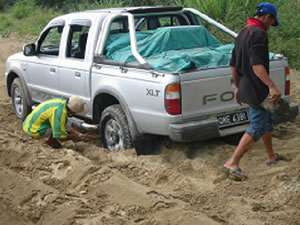 Wet season in peatland (photo) Wet season in peatland (photo) |
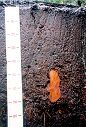
Peat profile
 |
| Soil respiration rate was highest in forest ecosystem on tropical peatland compared to oil palm and sago ecosystems. | ||
| The oil palm and forest ecosystems on tropical peatland behaved like aerobic system in most months whereas the sago ecosystem remained mainly anaerobic throughout the year. Thus, different factors regulated the activity of greenhouse gases in each ecosystem. | ||
|